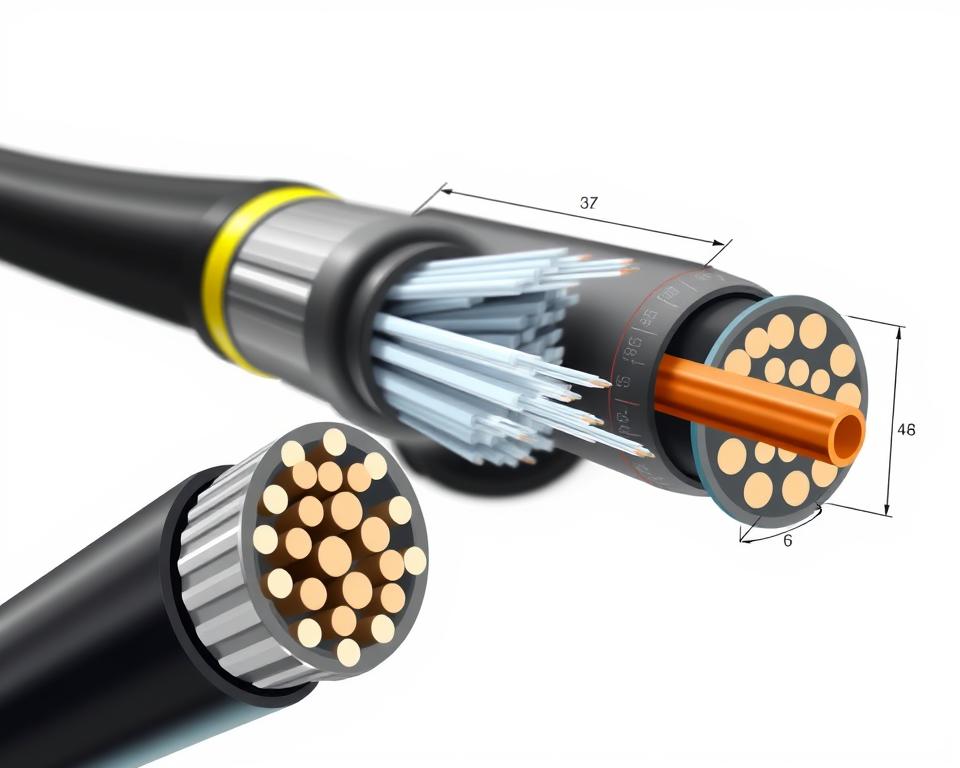
Precision Matters: A Deep Dive into the Fiber Coloring Machine

Under laboratory conditions, one optical fiber can carry over 100 terabits per second. This capability is rooted in the precision of the cable’s construction. For manufacturers, the FTTH Cable Production Line serves as the cornerstone for delivering reliable broadband, wireless networks, local-area networks, and data transmission.


This unified system includes processes such as fiber coloring, secondary coating, tight buffering, SZ stranding, extrusion, armoring, sheathing, tape wrapping, cooling, curing, and optical and mechanical testing. These processes collectively transform raw fiber into cables suitable for complex network installations.

Contemporary fiber optic cable manufacturing equipment can be tailored for FTTH drop cables, indoor cables, outdoor loose-tube designs, armored cables, and ribbon-based products. Some machines also cater to specific high-density datacom designs.

The production line design depends on the cable’s structure, fiber count, materials, production capacity, adherence to product standards, and the available factory space. Advanced systems can handle both single-mode and multimode fiber, including ITU-T G.652D and bend-insensitive G.657A1 and G.657A2 fiber.

This article examines the components, process options, automation, testing, installation, and long-term efficiency required for high-speed fiber cable production in the United States. It also explores how an adaptable FTTH cable manufacturing system can accommodate evolving market demands.

Key Takeaways

  • An FTTH Cable Production Line integrates multiple cable-making processes into a unified system.
  • Manufacturers can configure equipment for various cable types, including indoor, outdoor, armored, drop, and ribbon cables.
  • Fiber type, cable structure, materials, and factory layout all affect equipment choices.
  • Testing and process control are essential for maintaining optical performance and minimizing production waste.
  • Scalable machinery supports high-speed production and future cable variations.

What Is An FTTH Cable Production Line?

FTTH Cable Production LineFTTH Cable Production Line

An FTTH cable manufacturing line constitutes a sophisticated ensemble of machinery, transforming raw materials into sophisticated fiber-to-the-home cables. This process meticulously controls fiber tension, coating thickness, and cable geometry, ensuring precise material placement at each stage.

Communication and computer networks depend on cables with consistent dimensions and accurately positioned fibers. The production line integrates various systems, including fiber payoff, coloring, buffering, stranding, extrusion, cooling, testing, and take-up, within a unified, controlled framework.

Purpose Of An FTTH Cable Manufacturing System

The main purpose of this system is to protect delicate glass fibers while preserving their optical performance. By regulating tension, it prevents stress during the manufacturing process. The application of a consistent coating and precise jacket geometry facilitates smooth installation and ensures long-term signal transmission fidelity.

Contemporary FTTH drop cable production lines are capable of producing a variety of cable types, including flat and round drop cables, simplex, duplex soft cables, and tight-buffered cables. These systems offer flexibility, allowing manufacturers to customize production based on fiber count, jacket materials, strength members, and final diameters.

Typical FTTH Cable Structures And Applications

Indoor fiber optic cable lines support applications ranging from premises wiring and FTTA and FTTB deployments to local-area networks, patching areas, and building distribution. The common configurations include GJFJV, GJFV, simplex, duplex, and tight-buffered cables, each tailored for specific indoor use cases.

Outdoor networks, on the other hand, demand strong protection against environmental factors such as moisture, pulling force, crushing, temperature fluctuations, and ultraviolet radiation. The manufacturing of outdoor cables encompasses a variety of designs, including ADSS, ASU, GYXTC8S, GYXTPY, GYXTW, armored, loose-tube, aerial, duct, and direct-buried cables, each designed for specific outdoor applications.

Diverse cable structures are optimized for different installation scenarios. Tight-buffered cables are ideal for indoor handling, while loose-tube designs accommodate fiber movement due to temperature variations. Armored cables, with their added protection, are suited for challenging routes.

How Production Quality Affects Network Performance

Fiber cable quality directly affects attenuation, tensile strength, crush resistance, bending performance, and environmental durability. Inadequate fiber positioning or uneven coating can significantly increase signal loss. Weak jackets, conversely, may lead to damage during handling, bending, or installation.

Dimensional inspections, tension monitoring, optical measurements, and mechanical tests are important for producing consistent cable. Standards like IEC 60794 provide critical benchmarks for cable performance. ITU-T G.652D and G.657A1/A2 guidelines further specify fiber characteristics for standard, bend-sensitive, and access network applications.

Consistent manufacturing processes enhance installation efficiency and ensure stable service over the cable’s lifespan. For network operators, the reliability of production directly correlates with reduced field issues, expedited deployment, and dependable high-speed connectivity.

Essential Modules In Fiber Optic Cable Manufacturing Equipment

Every manufacturing stage helps protect the fiber and control its position. The process ensures accurate payout, alignment, and tension, preventing bends, scratches, and signal loss. These steps are critical in preparing the fiber for the subsequent cable assembly stages.

Fiber Preparation And Coloring Machinery

The initial stages of fiber preparation involve guiding each strand from the payoff reel with precise tension control. Alignment systems are integral in maintaining the fiber’s central position as it traverses the manufacturing line. Surface protection mechanisms are implemented to minimize damage during the coloring, buffering, and cable assembly processes.

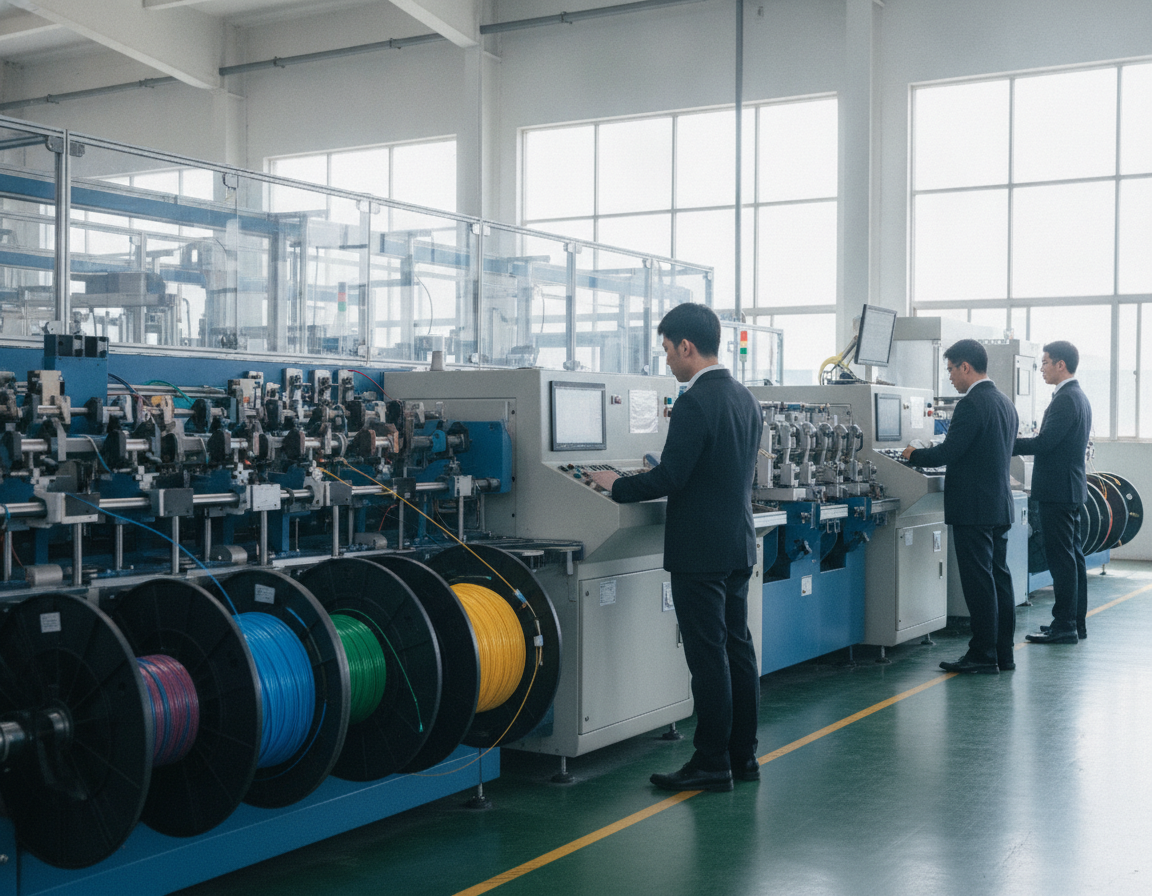
A specialized fiber coloring machine is responsible for applying distinct color coatings to each strand. These colors are essential for quick identification during the assembly and field termination phases. Some systems boast up to 12 coloring channels and UV curing speeds exceeding 1,500 meters per minute.

The fiber draw tower is instrumental in creating optical fiber from glass preforms. While it plays a significant role in broader fiber manufacturing operations, most FTTH cable lines utilize pre-manufactured optical fiber.

Secondary Coating And Buffering Equipment

The secondary coating line forms loose tubes around one or more fibers, utilizing either dry materials or a jelly-filled compound. This protective layer adds space, enhances protection, and allows for the fiber’s free movement within the cable.

The OFC 40 Secondary Coating Line supports high-speed production while maintaining controlled excess fiber length and consistent tube quality. These features are vital in maintaining cable dimensions during subsequent stranding and sheathing processes.

Tight-buffering machinery places a close-fitting polymer layer around the fiber, making it suitable for indoor cables requiring easy handling and direct termination. The choice of buffer type is contingent upon the cable’s structure, installation requirements, and necessary protection levels.

Stranding, Extrusion, And Sheathing Equipment

Stranding machinery organizes tubes, ribbons, or other elements around the core while controlling lay length and core shape. This process ensures stable cable geometry during pulling and installation, critical for maintaining performance.

Extrusion and sheathing units apply protective jackets for both indoor and outdoor applications. Common materials include PE, PVC, and LSZH. Temperature, pressure, and cooling control are essential in producing a smooth, accurately dimensioned jacket.

Complete optical fiber cable-making systems may include steel tape or wire armoring equipment. Yarn application, tape wrapping, and cable testing are integral components of these lines. These modules enable manufacturers to tailor protection levels to various applications, including aerial, buried, indoor, and direct-burial installations.

Production Module Main Function Typical Manufacturing Benefit
Fiber preparation Controls payout, alignment, tension, and surface protection Helps reduce fiber damage before assembly
Fiber color-coding machine Adds color coatings to identify individual fibers Supports up to 12 channels and UV curing above 1,500 meters per minute
Fiber draw tower Draws optical fiber from preforms Used in fiber manufacturing operations, not most FTTH cable lines
Secondary fiber coating line Creates dry or jelly-filled loose tubes Provides stable excess fiber length and consistent tube quality
Tight-buffering unit Applies a close-fitting polymer layer Supports compact indoor cable designs
Cable stranding unit Organizes tubes, ribbons, or cable elements around the core Maintains cable shape and controlled lay length
Cable extrusion and sheathing unit Places PE, PVC, or LSZH protective jackets Protects cables used in indoor and outdoor installations
Armoring and testing modules Adds steel armor, yarn, tape, and test functions Supports demanding routes and documented quality checks

FTTH Cable Production Line Configuration Options

Fiber cable plants can be tailored for one product or multiple cable families. The optimal setup hinges on cable structure, fiber count, materials, production speed, and testing requirements. A modular design facilitates manufacturers in balancing output, floor space, and future growth prospects.

Indoor And Drop Cable Configurations

A typical FTTH drop cable production line integrates fiber payout, coloring or identification, strength-member handling, extrusion, cooling, take-up, and inline inspection. This sequence ensures stable dimensions and precise fiber placement. It accommodates common drop cable designs for residential, commercial, and access networks.

An indoor cable production line can produce simplex, duplex, GJFV, GJFJV, tight-buffered, premises, and soft cable designs. It employs aramid yarn, fiberglass rods, or other strength members. Material selection is contingent upon bend performance, pulling force, flame behavior, and installation conditions.

The OFC 43 Premises Cable Extrusion Line supports both indoor and FTTH designs. Its process encompasses stranding, yarn application, and extrusion. This adaptable layout enables a plant to transition between small premises cables and selected access cable designs with minimal production adjustments.

Outdoor Loose-Tube And Armored Cable Options

An outdoor fiber optic cable line commences with secondary coating. The process then involves SZ stranding, strength-member application, water-blocking materials when necessary, and final jacketing. These steps safeguard fibers against moisture, tension, temperature fluctuations, and movement during installation.

The OFC 40, OFC 70, and OFC 60 process sequence comprises three primary stages: loose-tube production, SZ stranding, and final cable jacketing. Each stage is customizable to match the target core count, tube design, cable diameter, and jacket material. Inline controls ensure consistent tube size and cable geometry across extended production runs.

Armored designs incorporate steel tape or steel wire wrapping for enhanced mechanical protection. Adjustable tension prevents gaps, deformation, and excessive pressure on the cable core. This configuration is suitable for direct-burial, duct, industrial, and other demanding outdoor applications.

Customized Production Lines For Cable Requirements

Custom configuration begins with the product drawing. Engineers scrutinize core count, fiber type, cable diameter, sheath material, production speed, quality standards, and plant layout. This review determines the necessary payoffs, extruders, stranders, cooling systems, take-ups, and inspection devices.

Manufacturers may select separate process modules or a complete turnkey fiber optic cable production line. A plant may require one extrusion unit for a focused product range. Larger facilities might integrate coloring, buffering, stranding, armoring, jacketing, and testing equipment.

An advanced FTTH cable extrusion line can accommodate new materials, tighter tolerances, and faster changeovers. Existing lines can be upgraded with newer controls, improved cooling, modern inspection tools, or efficient drives. These enhancements extend service life, boost productivity, and maintain competitiveness.

Project teams seeking high-quality FTTH cable production solutions should evaluate output targets against product variety and available floor space. A well-matched configuration minimizes material waste and ensures stable, repeatable production.

Configuration Primary Process Modules Common Applications Main Design Priority
Drop cable Fiber payout, identification, strength-member handling, extrusion, cooling, take-up, and inline inspection Access drops and short subscriber connections Small diameter, bend performance, accurate fiber placement
Indoor cable Fiber payout, tight buffering, yarn application, extrusion, cooling, and take-up Simplex, duplex, GJFV, GJFJV, premises, soft, and tight-buffered cables Flexibility, flame performance, low installation force
Outdoor loose-tube cable Secondary coating, SZ stranding, strength-member application, water blocking, and jacketing Duct, aerial, direct-burial, and access network cables Moisture protection, tensile strength, and temperature stability
Armored fiber cable Loose-tube or stranded core, steel tape or wire wrapping, final jacketing Industrial, direct-burial, and high-protection installations Adjustable armor tension and mechanical protection
Customized turnkey line Individual modules or a complete integrated manufacturing system Special cable designs and varied product portfolios Product drawings, speed, standards, layout, and upgrade path

Fiber Coloring, Secondary Coating, And Tight Buffering Methods

Fiber processing begins with bare fiber or fiber that already has a 250 µm primary coating. A specialized fiber coloring machine then applies a precise, thin layer to each fiber within a multi-fiber cable. This meticulous process ensures swift identification during the subsequent splicing and installation phases.

Modern coloring systems can process as many as 12 channels at the same time. Utilizing UV curing equipment, the color layer is solidified at velocities exceeding 1,500 meters per minute. Ensuring stable fiber tension, uniform ink flow, and consistent curing processes are imperative to avert irregular coloration, surface imperfections, and damage to the fiber.

Following the coloring phase, a secondary coating line envelops one or more fibers within a protective sheath. This line can generate either dry loose tubes or jelly-filled counterparts. Each configuration necessitates a stable excess fiber length, accommodating variations in temperature and mechanical stress.

Tube dimensions must remain consistent during extrusion, cooling, and post-shrinkage. Maintaining a consistent tube profile is critical for preserving the cable’s geometry and mitigating stress on the optical fiber. Achieving precise material flow and controlled cooling is essential to minimize dimensional discrepancies across extended production periods.

Tight buffering is an important process for producing indoor and FTTH cables. It encompasses the formation of tight-buffered fibers, semi-tight buffers, and micro-sheath products. Hytrel, PVC, and LSZH are commonly employed as buffer materials, with tight-buffer layers produced within a 600–900 µm extrusion range.

Water trough cooling is employed to dissipate heat from the newly formed buffer layer. Subsequent UV drying or curing may be necessary, contingent upon the material system’s requirements. These steps are critical for stabilizing the final profile and facilitating clean winding, connector preparation, and cable assembly.

Process control integrates fiber tension, material temperature, die alignment, curing conditions, and take-up speed. Operators meticulously monitor these parameters to minimize the occurrence of bubbles, ovality, surface defects, and excess scrap. Achieving a harmonious process balance is essential for safeguarding the fiber while maintaining the cable’s optical integrity.

SZ Stranding Technology For FTTH And Outdoor Fiber Cables

An SZ stranding line places tubes, ribbons, or other cable elements around a central core while changing the lay direction at set intervals. This method facilitates the creation of flexible cable geometries and controlled core formations.

Alternating lay directions allow fibers to move within the cable. This movement aids in managing strain during bending, pulling, and temperature fluctuations. Such a technique is predominantly employed for outdoor applications and in the production of dense fiber cable cores.

How SZ Stranding Works

The SZ stranding process involves the use of payout units to guide tubes or ribbons towards a central strength member. The stranding head, rotating around the core, changes direction at intervals determined by the lay length. A binding unit secures the elements in place before they reach the take-up system.

The OFC 70 SZ-Stranding Line is engineered for high-speed stranding of various cable elements. It supports controlled lay lengths, precise binding, and accommodates long production batches. Depending on the configuration, it can handle up to 24 fibers, with rotation speeds reaching 3,000 rpm.

Advantages Of Servo-Controlled Stranding

Servo-controlled stranding ensures synchronization among payout, rotation, binding, and take-up systems. Each servo motor adjusts to production settings in real-time. This synchronization enhances lay-length accuracy and maintains consistent binding tension.

Stable synchronization contributes to a uniform cable diameter, reducing fiber stress. It facilitates smoother handling during extrusion and sheathing processes. The consistent core geometry ensures reliable optical performance across extended production runs.

  • Accurate lay length for stable core formation
  • Balanced tension across tubes and ribbons
  • Coordinated take-up for smooth, continuous production
  • Lower risk of fiber movement and excess strain
  • Better process control for high-speed fiber cable production

When An FTTH Facility Needs SZ Stranding

SZ stranding suits outdoor loose-tube cables, ribbon-based designs, and cable cores containing many organized elements. It offers manufacturers a flexible platform for producing high-count products, trunk cables, and network cables for challenging routes.

Facilities focused solely on simple FTTH drop cables might not require a full SZ stranding line. Diversified plants, on the other hand, can use the equipment for expansion into outdoor cables, high-density products, and longer production batches.

SZ super-bundling is a related process for combining rollable ribbon bundles into structured super bundles. These bundles are suitable for compact datacenter interconnect cables, where fiber density, flexibility, and organized routing are critical.

Fiber Cable Extrusion And Sheathing For FTTH Protection

Extrusion applies an outer jacket to the fiber cable, helping protect it from moisture, abrasion, and other environmental conditions. The jacket must endure exposure to sunlight, temperature fluctuations, and other outdoor elements. A well-controlled extrusion process ensures the cable’s performance remains stable from the manufacturing stage to its deployment.

Jacket Materials For Indoor And Outdoor Cables

Polyethylene (PE) is a prevalent choice for outdoor cable jackets due to its resistance to water and weather. This makes PE fiber cable jackets ideal for direct burial, aerial, and duct applications. The material can be customized for enhanced flexibility, strength, and environmental resilience.

PVC and LSZH are commonly used for indoor cable designs. PVC supports durable jackets and buffer layers, suitable for general building applications. LSZH fiber cable production is preferred where low smoke and reduced halogen emissions are critical during fires.

Hytrel is used in tight-buffer applications that require flexibility and reliable recovery. PVC and LSZH can also serve as buffer or jacket materials, depending on the cable’s structure. The OFC 60 Jacketing Line is designed for the final outdoor protection and flexible cable designs. It operates at a sheathing speed of approximately 60–90 meters per minute, contingent on cable diameter, material, and configuration.

Cooling, Curing, And Dimension Control

After the polymer exits the die, cooling troughs are used to stabilize the extruded profile. Maintaining consistent water temperature, flow rate, and contact time is essential. These factors are critical in preserving the jacket’s diameter and minimizing surface defects.

UV dryers or curing systems may be employed to support compatible coating and marking processes. Integrating energy-saving extrusion and UV-curing technologies can significantly reduce operating costs. A well-controlled line ensures high output without compromising the fiber core.

An advanced FTTH cable extrusion line uses sensors and control systems to regulate important process points. Parameters such as die centering, melt temperature, extrusion pressure, line speed, cooling-water stability, jacket concentricity, and take-up tension all impact cable quality. Even minor adjustments in these settings can affect wall thickness and cable flexibility.

Fiber Cable Sheathing Line Performance Factors

A fiber cable sheathing line must align with the planned cable range, polymer types, and target output. The design of the screw, crosshead accuracy, cooling length, haul-off control, and take-up capacity all influence stable production. The line should facilitate quick size changes, accommodating multiple FTTH cable designs in a factory setting.

Every jacket should be checked for diameter, ovality, surface finish, adhesion, tensile strength, and elongation. Environmental tests assess resistance to heat, moisture, chemicals, sunlight, and repeated bending. These evaluations confirm the jacket’s effectiveness in protecting the cable during installation and service.

  • Outdoor designs often use PE for moisture and weather resistance.
  • Indoor cables may use PVC for durability and straightforward processing.
  • LSZH materials are suitable where smoke and halogen limits are strict.
  • Hytrel may be used in tight-buffer cables that need flexibility and recovery.
  • Servo-controlled take-up systems help maintain consistent tension and cable diameter.
Application Common Material Main Protection Need Important Process Checks
Outdoor FTTH fiber cable Polyethylene Moisture, sunlight, abrasion, and temperature changes Wall thickness, concentricity, cooling stability, and surface finish
Indoor distribution fiber cable Polyvinyl chloride Flexibility, abrasion protection, and simple installation Diameter, ovality, tensile strength, and take-up control
Low-smoke indoor fiber cable LSZH Lower smoke and halogen emissions during fire Melt control, surface quality, elongation, and flame-related testing
Tight-buffer cable Hytrel, PVC, or LSZH Flexibility, fiber protection, and predictable stripping Buffer fit, adhesion, recovery, diameter, and bending checks

Fiber Ribbon Line And Compact Fiber Unit Solutions

Ribbon production involves arranging multiple optical fibers in a flat, ordered structure. This method increases fiber density and facilitates rapid mass splicing in high-count cables. It is ideal for datacenter links, central-tube cables, and other space-constrained networks.

Ribbon-Based Cable Production

The OFC 45 Ribbon Buffering Line generates dry and jelly-filled ribbon tubes. These tubes are designed for central-tube and ribbon-based loose-tube cable structures. Controlled buffering safeguards the fibers while maintaining the tube’s compactness, preparing it for subsequent stranding or jacketing.

Rollable ribbon production is essential for next-generation datacom systems. The OFC 23 Rollable Ribbon Line creates high-density rollable ribbons for datacenter cable designs. Their flexible nature allows for increased fiber density within a limited cable diameter.

The OFC 79 Rollable Ribbon Bundling Line assembles these ribbons into compact, cable-ready bundles. The OFC 70 SZ Super-Bundling Line then combines these bundles into structured super bundles for datacenter interconnect cable cores. An OFC 60 Jacketing Line can apply the final jacketing.

Fiber Ribbon And “Fiber Ribbone Line” Search Terminology

The phrase fiber ribbone line is often used as a spelling variation for fiber ribbon line. Despite the spelling variation, the technical process remains focused on ribbon production, buffering, bundling, or tube formation. The essence lies in the process control, not the spelling used in product searches.

Compact Fiber Unit Integration

A compact fiber unit combines one or more fibers, ribbons, strength members, and protective layers into one small subassembly. This format supports modular production and space-efficient cable designs. It enables a higher fiber count within restricted cable dimensions.

Compact units are integral to high-density datacom cable manufacturing plans, accommodating flexible product layouts. They can navigate through subsequent bundling, stranding, and jacketing stages with minimal adjustments to the main line. This approach facilitates the production of specialized designs without significantly increasing floor space requirements.

Automation, Testing, And Quality Control In Production

Reliable cable production requires dependable process controls, accurate test data, and rapid fault detection. A contemporary PLC fiber cable production line integrates each phase, from fiber payout to the final cable take-up. This configuration ensures consistent output over extended periods and facilitates uninterrupted operation around the clock.

PLC And HMI Production Controls

The integration of a Siemens PLC and HMI system orchestrates the entire process, from payout to take-up. It synchronizes line speed and material flow across all units, ensuring a seamless operation. The HMI interface empowers operators to access recipes, review alarm histories, monitor process values, and initiate emergency stops.

Correct fiber path alignment is essential for protecting the glass fiber as it moves through the line. Maintaining stable tension is equally important to prevent excessive attenuation, microbending, fiber breaks, and irregular cable geometry. The system allows for the saving of settings for various cable designs, including drop, indoor, and outdoor cables.

Optical And Mechanical Testing Of Cables

Optical fiber cable testing encompasses assessments of attenuation and continuity, as well as transmission performance and fiber identification. These evaluations confirm that each fiber adheres to the specified path and meets performance criteria. Automated testing records are linked to production batches, providing a clear audit trail.

A dedicated testing station may include evaluations for optical attenuation, tensile strength, crush resistance, and aging. Mechanical inspections cover tensile strength, crush resistance, heat aging, jacket condition, and dimensional accuracy. The selection of tests must align with the cable’s structure, jacket material, strength member, and intended installation environment.

Quality assurance starts by checking incoming optical fibers, polymer compounds, and strength members. It extends to the evaluation of finished cable dimensions, optical performance, jacket condition, and production records. Continuous monitoring alerts operators to any deviations from set limits, enabling prompt corrective actions.

Relevant Fiber And Cable Standards

IEC 60794 is an important reference for optical fiber cable specifications. Fiber characteristics may adhere to ITU-T G.652D for standard single-mode designs or ITU-T G.657A1 or ITU-T G.657A2 for bend-insensitive applications. The chosen fiber class must align with the cable’s structure and the network’s requirements.

Documentation may reference ISO 9001 quality systems, CE marking, and RoHS compliance. These references underscore the commitment to traceable production practices and responsible material selection. The test plan should reflect customer specifications, local regulations, and the cable’s intended use.

Control Area Key Functions Production Benefit
PLC And HMI Line synchronization, recipes, alarms, emergency stops, and process monitoring Consistent operation and repeatable production settings
Fiber Handling Control Path alignment, payout control, and tension regulation Reduced risk of attenuation, microbending, and fiber breaks
Optical Testing Attenuation, continuity, transmission, and fiber identification checks Confirmed optical performance
Mechanical Testing Tensile, crush, aging, jacket, and dimensional inspections Improved durability and cable consistency
Standards Control IEC 60794, ITU-T G.652D, ITU-T G.657A1, and ITU-T G.657A2 references Clear design and compliance targets

Choosing Efficient Fiber Optic Cable Manufacturing Equipment

Begin equipment selection by reviewing the planned cable portfolio rather than focusing only on individual machines. Determine the plant’s production scope, encompassing various cable types such as drop, indoor, outdoor, and others. This approach ensures that the FTTH cable equipment selection is precise, avoiding costly production capability gaps.

Production Output And Line Speed

Align output with forecasted demand, considering speed as a secondary factor. Coating and extrusion units can achieve speeds up to 1,000 meters per minute. In contrast, sheathing lines operate at approximately 60–90 meters per minute. The overall line output is determined by the slowest process, changeover time, and reel handling efficiency.

Evaluate fiber count, core diameter, cable diameter, lay length, material flow, reel size, and setup time. High-speed fiber cable production lines must maintain consistent tension across all speeds. Request test data specific to the cable designs intended for the plant.

Evaluation Point Why It Matters Information To Check
Line Speed Influences daily output and process balance Rated speed, working speed, and speed under load
Fiber Capacity Supports existing and future cable products Core count, fiber type, and supported diameter range
Changeover Time Influences the efficiency of small production batches Tool replacement, recipe storage, and reel-changing procedures
Material Processing Capacity Controls jacket and buffer consistency Resin flow, cooling demand, and waste rate

Materials, Product Range, And Upgradeability

Ensure the optical fiber cable making machines support both single-mode and multimode fibers. The system should accommodate various fiber types, including G.652D and G.657A1/A2. Verify compatibility with materials such as Hytrel, PVC, LSZH, PE, steel tape, and wire armor.

A modular cable production line can integrate multiple processes like fiber coloring, OFC 40 secondary coating, and OFC 60 jacketing. Request customization based on product drawings, core count, target speed, sheath materials, and required standards.

Modular equipment makes later expansion easier. Adding new buffering, stranding, or jacketing units can extend the life of existing equipment. This flexibility supports adapting to changing orders without replacing the entire fiber optic cable line.

Factory Space, Energy Consumption, And Maintenance

Review the factory before purchasing the equipment. Many systems require a 380 V AC ±10%, three-phase industrial supply. Power consumption may approach about 55 kW, depending on the configuration. Confirm the necessary floor space, material flow, reel movement, ventilation, cooling water, operator access, safety clearances, and expansion space.

Compare energy-efficient extrusion units and UV-curing systems with the products planned for manufacture. Review preventive maintenance tasks, cleaning needs, spare-parts access, and service clearance around each module. Clear records and easy access are essential for maintaining the productivity of optical fiber cable-making machines during extended production periods.

A carefully planned purchase considers capacity, materials, factory layout, energy consumption, and service support together. These considerations form a solid foundation for reliable FTTH production, avoiding unnecessary expenses on unused speed or features.

FTTH Cable Manufacturing Installation, Training, And Support

Reliable FTTH cable line installation begins with a carefully prepared factory plan. Suppliers must meticulously assess the floor area, production flow, access routes, and safety zones prior to equipment delivery. This foundational plan dictates the precise positioning of equipment, ensuring seamless coordination with utilities, line assembly, and cable routing.

Commissioning encompasses a series of critical steps, including power checks, air and water connections, control system setup, and process calibration. Engineers are dispatched upon equipment arrival, aligning with the equipment’s complexity, site readiness, and customer needs. Initial production verification is imperative to validate output quality before transitioning to regular operations.

Selecting a turnkey cable production system involves more than receiving machinery. It includes layout design, installation support, operator training, and detailed technical documentation. These documents are indispensable, detailing machine settings, wiring diagrams, operational procedures, maintenance tasks, and safety protocols. Such documentation is instrumental in minimizing downtime and ensuring efficient production management.

Good training for fiber optic cable machinery should combine technical instruction with hands-on practice. Operators must be proficient in handling fibers, loading materials, setting recipes, adjusting tension, and conducting extrusion, stranding, and cable testing. Training should also encompass routine cleaning, safe operation, alarm monitoring, and basic troubleshooting techniques.

Training modalities can vary, with on-site sessions providing hands-on experience and remote sessions facilitating review of control screens, recipes, and standard operating procedures. This dual approach ensures that operators are well-prepared to handle the complexities of the equipment.

  • Check fiber routing, tension control, and material-feed settings.
  • Check extrusion temperature, line speed, cooling, and jacket dimensions.
  • Inspect stranding settings, test results, and production records.
  • Practice safe shutdown, cleaning, inspection, and fault recovery.

Remote technical support is invaluable for addressing software settings, program faults, sensor alarms, and machinery malfunctions. A dedicated service team can review operational data, guide diagnostic procedures, and provide replacement support when necessary. Timely response is critical, given the operational demands of a production line serving active customer orders.

Preventive maintenance is essential, encompassing cleaning, lubrication, electrical inspections, calibration checks, and wear-part reviews. Modular equipment typically follows a maintenance cycle of approximately six months. The actual interval, influenced by operating hours, materials, dust levels, line speed, and site conditions, should be clearly outlined in a service plan.

Support Area Details To Confirm Before Purchase
After-Sales Response Support hours, response targets, escalation steps, and communication channels
Spare Parts Stock location, delivery times, compatible parts, and replacement instructions
Software Support Program backups, updates, access permissions, and remote diagnostic options
Warranty Coverage Coverage period, excluded items, labor terms, and claim process
Local Service Regional engineers, travel support, and available maintenance coverage

Made-in-China.com Secured Trading and similar services may provide payment protection, shipment tracking, optional pre-shipment inspections, and dispute assistance. It is imperative to confirm details such as freight costs, delivery dates, warranty coverage, and service conditions directly with the chosen supplier.

Benefits Of Advanced FTTH Cable Manufacturing Technology

Modern production systems give manufacturers precise control from fiber pay-off through to final jacketing. The integration of automated tension control, synchronized drives, stable extrusion, controlled curing, and precise stranding ensures the maintenance of cable dimensions and optical performance. This level of precision is critical for the production of advanced FTTH cables, catering to the demands of complex network projects.

Consistent Cable Quality And Lower Production Waste

Accurate process control is instrumental in maintaining a stable excess fiber length throughout the cable production process. This control supports controlled post-shrinkage, accurate lay length, precise binding, and repeatable jacket dimensions. Such factors are essential in reducing stress on the fiber, ultimately protecting signal quality during both installation and service.

Steady line control significantly minimizes fiber breaks, material waste, and rework. It allows for more predictable output across extended production runs. The adoption of energy-saving extrusion systems and UV-curing technology further contributes to lowering operational costs, aligning with the goal of low-waste cable production.

Flexible Manufacturing For Changing Market Demand

A well-configured line can produce a diverse range of cables, including indoor, outdoor, FTTH, armored, ribbon, loose-tube, and tight-buffered varieties. The same equipment platform can also support datacom, hybrid, and composite designs with the addition of specific process modules. This adaptability enables manufacturers to respond to shifts in local broadband, data center, and enterprise network demands.

Individual process steps can be installed incrementally, allowing for expansion as orders increase. Modular equipment supports various functionalities, including rollable ribbon, fiber bundling, SZ super-bundling, and final jacketing. These capabilities cater to both high-density data center interconnect cables and standard FTTH products.

Modular upgrades can modernize older lines without necessitating the replacement of every machine. New controls, drives, tension systems, and testing units can extend the service life of equipment and enhance productivity. This strategy safeguards existing investments while pursuing the latest advancements in fiber cable manufacturing technology.

Scalable Solutions For High-Speed Fiber Cable Production

Industrial lines designed for long batches and continuous operation can significantly increase output while maintaining process stability. Automated line synchronization ensures that pay-off, stranding, extrusion, curing, and take-up units operate at a consistent pace. These features are essential for high-speed fiber cable production, facilitating large-scale network deployments.

Effective FTTH cable production solutions involve more than high-speed machinery. They encompass operator training, global installation support, process guidance, and lifetime technical assistance from the supplier. Skilled teams can promptly identify process changes, ensuring reliable production over time.

Scalable equipment allows manufacturers to align production capacity, cable quality, and future network demand. This alignment provides a practical framework for growth across residential broadband, enterprise systems, and high-density fiber infrastructure.

Final Thoughts

A modern FTTH Cable Production Line combines fiber preparation, coloring, secondary coating, buffering, stranding, extrusion, sheathing, testing, and automation in one coordinated workflow. Each phase ensures stable optical performance, precise dimensions, and reliable cable protection.

The selection of the appropriate setup hinges on cable design, fiber count, materials, adherence to standards, production volume, available factory space, and future expansion plans. Essential components include a fiber coloring machine, a fiber secondary coating line, a tight buffering line, an SZ stranding line, an advanced FTTH cable extrusion line, a fiber cable sheathing line, a fiber ribbon line, and compact fiber unit solutions.

Manufacturers must focus on maintaining controlled fiber tension, utilizing reliable materials, implementing automated monitoring, and conducting thorough quality tests. Optimal FTTH cable production solutions might encompass single process modules or complete turnkey systems, catering to various cable types such as indoor, outdoor, FTTH, armored, ribbon, and high-density datacom cables.

Using suitable fiber optic cable manufacturing equipment can improve production output while reducing waste. Scalable, upgradeable systems are instrumental in ensuring reliable broadband deployment, fortifying FTTH network manufacturing, and fostering long-term competitiveness.

Custom Mold Services Dallas – From Concept to Production-Ready Molds

Precision machining provides the accuracy, repeatability, and dimensional control required throughout aerospace, medical, and industrial manufacturing. CNC Lathe Machining in Dallas supports tight tolerances, stable surface finishes, and consistently repeatable production results. This controlled manufacturing approach substantially reduces corrective work, rejected components, and avoidable machine downtime. Multi-technology machine shops combine multi-axis mills, CNC lathes, EDM equipment, waterjet cutters, and laser-processing systems. This combination enables intricate components to move through production with fewer setups, less repositioning, and reduced supplier handoffs. The result is improved cycle performance and stronger component quality for products such as engine parts, landing-gear components, and avionics housings.

Strong regional visibility helps Dallas machine shops demonstrate capability, establish trust, and connect with prospective clients and workers. Dallas shops showcase their machinery, workflows, inspection processes, and customer projects on Instagram and other social networks. This marketing approach attracts prospective buyers while also helping companies recruit skilled machinists, programmers, and technicians into the Dallas CNC machine shop community.

Real-world implementations such as Paramount Machine’s adoption of Datanomix demonstrate how Automated Production Intelligence can improve manufacturing visibility. By linking to shop-floor machinery, the software captures genuine utilization, running time, idle periods, and production behavior. With clearer performance information, machining companies can quote more precisely, eliminate inefficiencies, and generate stronger financial returns.

This review presents usable insights into machining equipment, material strategies, process optimization, and resulting business performance. Attention is directed toward repeatable strategies that can be introduced by machining services in Dallas and throughout the broader regional manufacturing ecosystem.

CNC Lathe Machining In Dallas: Case Study Overview

This analysis explores the role of high-accuracy CNC turning within Dallas production environments. Particular attention is given to sectors that depend on complex geometries, demanding dimensional limits, and consistent production results. The case study covers equipment selection, manufacturing controls, workpiece handling, tool management, and data-driven production tracking. Together, these methods strengthen quoting, increase productive machine time, and improve operational performance. Customer comments and visible project examples help validate performance while building confidence in the selected manufacturing partner.

Objectives And Scope Of This Machining Review

The primary objective is to show how consistent, controlled processes reduce waste and accelerate the production of critical components. It reviews setup strategies, inspection methods, and data-collection practices used to support continual improvement. The study places particular emphasis on monitoring cycle duration, tool life, machine activity, and material traceability during prototype and production work.

Industries Supported In Dallas: Aerospace, Medical, Defense, Automotive, And Industrial

Aerospace manufacturers require exceptional accuracy for products including engine parts, landing-gear components, and electronic housings. Defense applications demand durable designs, controlled materials, traceable production records, and repeatable quality. Healthcare components rely on approved materials, carefully managed surface conditions, and highly accurate finishing. Automotive and general industrial buyers typically prioritize scalable output, dependable delivery, and competitive production costs.

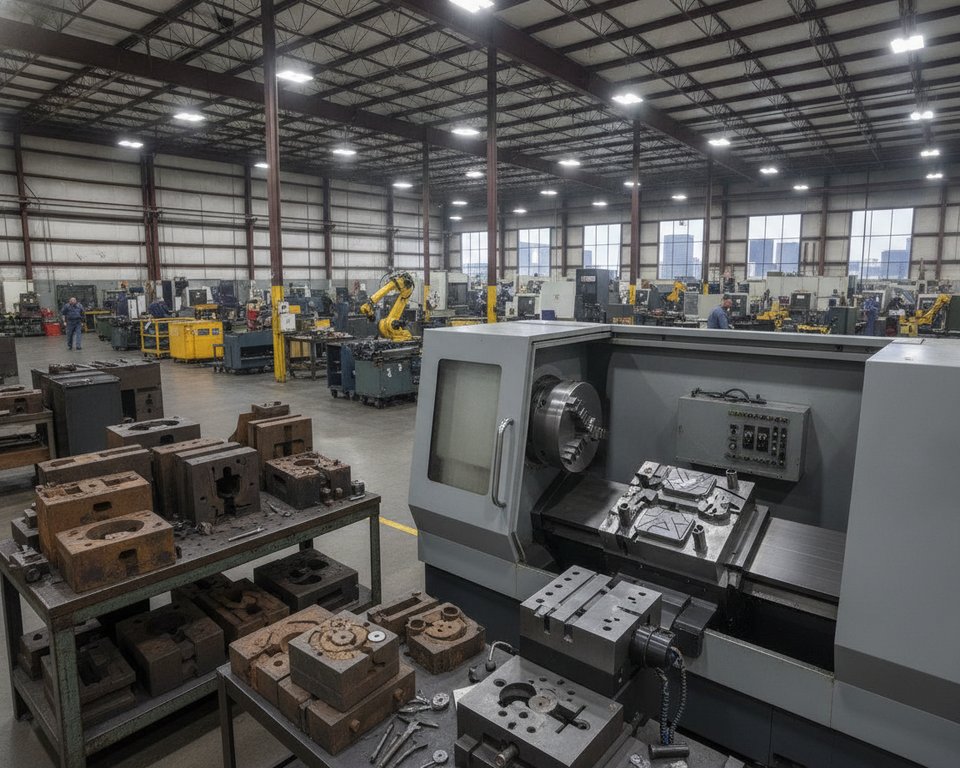
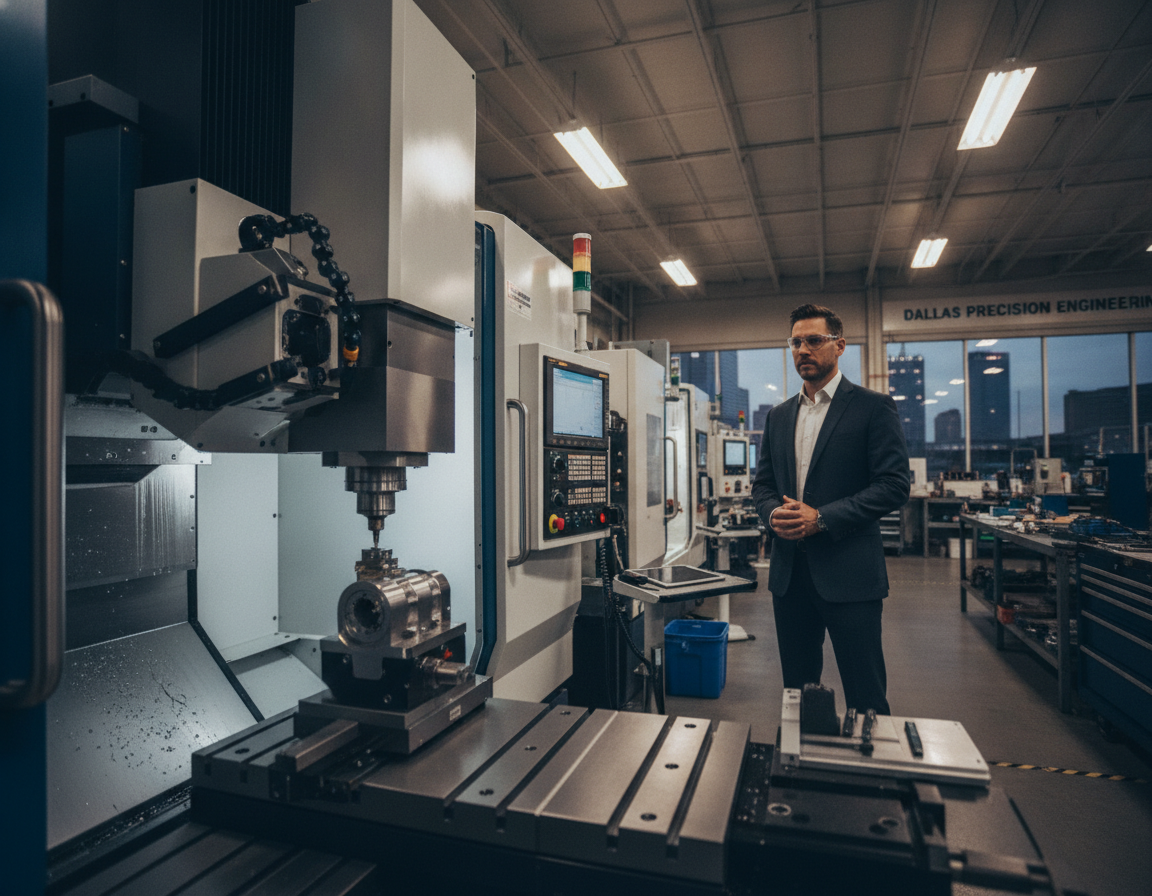
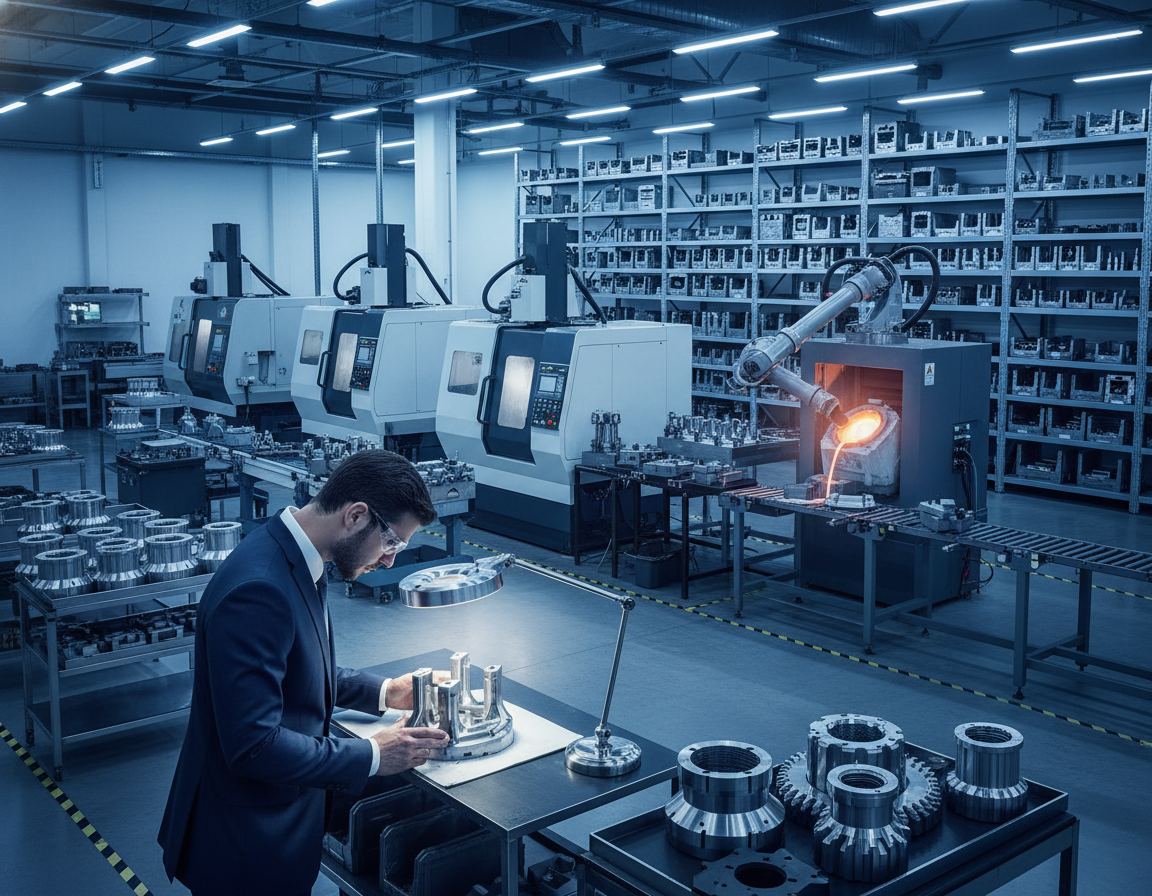
Custom Mold Services DallasCustom Mold Services Dallas

Lowrance Machine Profile And Local CNC Machine Shop Services

Through CNC milling, precision turning, and Datanomix monitoring, Lowrance Machine supports Dallas customers with improved manufacturing visibility and equipment performance. Its services include multi-axis production, accurate CNC turning, specialized tooling, and adaptable processes covering short development runs through long-term manufacturing.

Capability Operational Advantage Typical Use
Multi-axis milling Fewer setups and efficient production of complex geometries Useful for aircraft enclosures and precision medical components
High-precision lathes Improved roundness, dimensional repeatability, and finish quality Important for engine hardware and precision shaft production
Tooling for specialty fasteners Consistent production of custom threads, profiles, and head designs Supports custom fasteners Dallas and specialized assembly requirements
Real-time production intelligence Live uptime, utilization, and cycle-performance analytics Supports stronger estimates and job costing for Dallas CNC shops
In-process and final inspection resources Early error detection through sensors, vision equipment, and CMM inspection Confirms compliance with aerospace and medical specifications
Flexible custom-production processes Efficient transition from sample components to ongoing manufacturing Supports scalable Dallas custom-fastener and specialty-part production

Machining Technology And Production Resources In Dallas

Dallas machine shops use advanced mills, turning centers, inspection equipment, and skilled bench work to satisfy demanding aerospace and industrial requirements. These shops combine sophisticated CNC technology with traditional machining knowledge to handle development work, corrective repairs, and production quantities. By reviewing immediate utilization data, supervisors can distribute work more effectively and reduce equipment inactivity.

Advantages Of Multi-Axis And 5-Axis Machining In Dallas

Multi-axis platforms combine rotational and linear movement to reduce setup requirements for complicated aerospace components. Completing more work in a single setup lowers fixture requirements and improves finish consistency across freeform surfaces. Shops using 5-axis machining in Dallas report fewer manual operations and better feature alignment on parts with demanding contours.

Dallas Turning Capabilities: CNC Lathes, Tools, And Tolerance Control

Premium turning centers and live-tool lathes support accurate machining of difficult alloys such as titanium and stainless steel. Shops use precision workholding, hydraulic clamping, and replaceable inserts to maintain consistency during extended manufacturing cycles. Successful CNC lathe machining in Dallas depends on thermal compensation, rigid machine construction, controlled workholding, and proactive tool-wear management.

Dallas CNC Milling And Manual Machining Integration

CNC milling Dallas equipment efficiently produces detailed pockets, narrow profiles, and complex machined features. Traditional manual machining continues to support custom fixtures, single components, repair work, and small fitting corrections. Combining both workflows enables parts to progress smoothly from prototype development into controlled production while preserving accuracy and traceability. Industrial machining services in Dallas that unite automated milling with experienced manual finishing can deliver faster results for custom and low-volume projects.

Improving Machining Processes And Production Performance

Machining performance is commonly improved through many targeted changes instead of one isolated solution. Shops may refine cutter selection, coolant blends, fixture design, and machine code to improve overall output. The objective is to shorten machining cycles without sacrificing tolerance control, surface quality, or process reliability. These methods improve productive capacity across Dallas machining providers and support more efficient completion of specialized CNC work.

Reducing cycle time depends heavily on minimizing setups and creating more efficient toolpaths. Dallas 5-axis teams apply adaptive feeds, controlled chip removal, and carefully sequenced operations to improve production. These practices reduce noncutting movements, unnecessary pauses, and manual handling. By measuring spindle hours and downtime, planners can identify idle equipment and shift production accordingly.

Automated production intelligence provides immediate visibility into actual shop-floor performance. Live reporting systems capture production speed, idle events, delay reasons, historical jobs, and equipment activity. With detailed operating information, providers can refine pricing, understand job expenses, and eliminate margin-reducing inefficiencies.

Leaders can use monitoring information to uncover patterns of downtime linked to tool condition, coolant changes, and workflow delays. Corrective actions may include scheduled tool changes, revised coolant-management procedures, or updated operating instructions that preserve surface quality. Accurate capacity and costing data supports better make-or-buy decisions for Dallas machining operations.

Modern quality-control workflows increasingly include inline sensors designed to prevent errors before they create scrap. Integrated cameras verify that parts are loaded correctly and that key features exist during setup and ongoing runs. Laser-based inspection tools evaluate critical profiles and dimensions prior to additional processing. Coordinate measuring machines provide final dimensional confirmation for selected production samples and completed lots.

Multiple levels of quality verification reduce rejected components and rework while supporting compliance with aviation and healthcare specifications. Strong process controls also reduce emergency repair demands and integrate with industrial machine repair Dallas planning when equipment problems arise.

Maintenance teams use monitoring data to schedule preventive work that protects machine availability and extends productive life. Automated alerts identify emerging concerns such as spindle instability, coolant-quality problems, and worsening machining performance. These signals prompt timely industrial equipment repair Dallas support or targeted component replacement. The partnership between production data and maintenance planning reduces disruption and strengthens delivery reliability.

Specialty Components, Materials, And Dimensional Requirements

Dallas machine shops process a broad selection of aerospace and industrial materials with different cutting and handling requirements. Frequently machined materials include 6061 and 7075 aluminum alloys, Ti-6Al-4V titanium, specialty steels, and engineered composite sheets. Each stock type demands specific cutter geometry, machining speeds, fixture strategies, and cooling practices to control wear and temperature.

When cutting aluminum, shops favor polished and positive-rake tools capable of supporting fast material removal. For titanium work, manufacturers use lower chip loads, strong fixtures, and coated cutters designed to resist heat and wear. To protect composite laminates, shops employ specialized drills, extraction systems, and low-damage clamping methods. These material-specific techniques are important for CNC lathe machining Dallas projects requiring stable finishes and repeatable dimensions.

Engine hardware, landing-gear parts, and avionics enclosures require temperature control and repeatable setup conditions to maintain precision. Precision turning centers equipped with thermal compensation can provide micron-level repeatability when combined with in-process probing and routine calibration. Inspection plans may combine coordinate-measuring machines, laser profiling, gauges, and statistical process control to keep components within specification.

High-accuracy fixturing with multiple stations minimizes loading errors and supports consistent machining cycles. Industrial machining providers in Dallas feed measurement information back into production to identify changes before defective quantities accumulate. The approach limits corrective machining and helps suppliers deliver important aerospace components on time.

Dallas suppliers frequently manufacture specialty components such as custom fasteners, cast inserts, threaded sleeves, and mold inserts. Producing specialty fasteners can involve heading, machining, thread creation, heat treat, protective coating, and quality verification. The combined workflow supports aviation standards concerning mechanical strength, corrosion protection, precision, and production records. Machined inserts require exact shoulders, threads, and press-fit dimensions for dependable use in aluminum or composite structures.

Tooling inserts often demand mirror-like finishes, precise geometry, and strict flatness limits. Shops frequently combine CNC lathe machining Dallas for rotational details with CNC milling or EDM for cavities and noncircular geometry. Data-based quotations and utilization tracking help suppliers protect margins on specialty runs while maintaining competitive lead times.

Component Common Material Primary Manufacturing Steps Typical Dimensional Limit
Precision engine spindle Ti-6Al-4V alloy Rough and finish turning followed by heat treat, grinding, and dimensional verification Approximately ±0.005 mm
Landing-gear bushing Aerospace 7075-T6 aluminum alloy Lathe production followed by reaming, anodize treatment, and operational inspection Approximately ±0.02 mm
Avionics housing Heat-treated 6061-T6 aluminum alloy Machining, deburr operations, cleaning, and enclosure leak inspection A general tolerance of ±0.05 mm
Custom fastener Heat-treatable steel alloy Heading, CNC turning, heat treatment, and coating ±0.03 mm
Cast insert Bronze or stainless steel Final turning, thread creation, dimensional measurement, and press-fit testing ±0.04 mm
Hardened mold component Hardenable H13 tooling steel EDM shaping followed by machining, finishing, polishing, and dimensional validation A precision tolerance of ±0.01 mm

Close cooperation among product designers, machinists, programmers, and inspection personnel shortens development schedules and reduces avoidable revisions. Dallas suppliers with multiple capabilities show how complex components can move efficiently from prototype quantities into larger production runs. By balancing efficiency and accuracy, local machining services can meet demanding aerospace specifications while maintaining attractive costs and schedules.

Custom Mold And Insert Services Connected To CNC Lathe Machining

CNC turning forms an important foundation for mold-building and tooling work throughout the Dallas market. Precision lathe work and milling create the primary forms used for mold cavities, cores, rotational components, and tooling inserts. Accurate machining ensures mold components fit correctly and produce stable results throughout repeated molding cycles.

Capabilities And Workflow For Custom Mold Services In Dallas

Regional suppliers rely on CAM software and advanced machining centers for challenging mold forms. Programmers develop detailed toolpaths, secure workpieces in custom fixtures, and apply high-speed finishing passes to achieve specified surface standards. Electrical-discharge machining completes fine details and inaccessible geometry beyond the capabilities of ordinary milling tools.

Repeatability depends on suitable cutter selection, stable fixtures, controlled machine parameters, and verification during production. These controls allow custom mold services Dallas providers to maintain uniform cavity geometry and accurate bore concentricity during demanding production cycles.

Dallas Injection, Rubber, And Industrial Mold Production

Dallas injection-mold projects depend on precise cavity forms, material-flow paths, gate locations, and sealing features. CNC turning produces cores, sleeves, and cylindrical inserts with exact diameters and low runout. Dallas rubber-mold applications depend on controlled draft and polished surfaces that reduce excess material and cleanup.

Industrial molds Dallas programs often involve larger tools, substantial plates, and stronger wear-resistant alloys. Initial geometry is produced through turning and milling, followed by polishing and other finishing processes to meet tolerance and texture requirements.

Mold Builder Relationships And CNC-Turned Mold Components

Mold builder Dallas companies collaborate with local machine shops to convert design intent into practical, manufacturable tooling components. Accurate turning produces cylindrical mold parts whose dimensions and alignment match the intended cavity design.

Production-monitoring information and historical job records allow mold builders to plan capacity, forecast costs, and schedule maintenance more effectively. This coordination shortens project schedules and improves dimensional compatibility between molded components and subsequent assembly operations.

Component Representative Production Steps Quality Check
Injection-mold cavity block CNC rough machining, multi-axis surface finishing, and EDM for intricate features Coordinate measuring machine inspection and surface profilometry
Core pin or sleeve Swiss turning or CNC lathe machining, heat treatment, and final grinding Diameter, runout, surface, and hardness verification
Precision insert used in an overmold tool Advanced CNC milling combined with lathe work and surface finishing Visual examination and dimensional sampling
Template for a rubber mold Soft-tool construction, CNC finishing, and texture application Material-performance testing with size and form inspection
Precision plate for industrial tooling Milling and slotting followed by stress reduction and final flatness finishing Surface-plate measurement for flatness and parallelism

Operational Reliability Through Maintenance And Repair

Reliable machinery is essential for machine shops seeking consistent output, dependable delivery, and long-term competitiveness. Preventive attention to heat, vibration, bearings, lubrication, and cutting tools reduces the likelihood of unexpected failure. Such practices protect finish consistency and close tolerances for aviation, healthcare, and similarly demanding work.

Dallas shops often use both in-house technicians and certified repair specialists to resolve equipment problems quickly. Qualified repair technicians handle problems involving hydraulics, motors, servos, electrical circuits, and machine-control systems. Organized repair scheduling and parts availability allow failed machines to return to production more rapidly.

A formal preventive-service program changes maintenance from emergency response into planned equipment care. Effective maintenance systems document mechanical checks, vibration trends, fluid condition, lubrication, warning events, and prior repairs. Consistent records prevent avoidable interruptions and demonstrate controlled maintenance to customers and auditors.

Real-time intelligence can reveal underperforming machines early enough for corrective action. Dashboards alert operators to slower cycles, increased idle time, abnormal loads, and accelerating tool wear. Dallas shops with automated monitoring can diagnose problems faster while reducing manual reporting and data entry.

Case studies show that relatively small corrections can restore production capacity surprisingly quickly. A line may recover during one work shift after technicians change worn bearings, revise offsets, tune cutting parameters, or correct coolant problems. Local industrial machine repair Dallas companies often maintain or source critical spare parts to accelerate the recovery process.

A shop’s ability to recover from disruption is strengthened by technician training and organized spare inventory. Employees trained across multiple systems, supported by written service procedures and critical-parts inventories, can respond more effectively. These measures strengthen customer confidence that precision components will continue to arrive according to agreed schedules.

Business Impact And Measured Outcomes From The Case Study

Strategic changes to machining processes and data visibility produced measurable operational gains throughout the shop. Key indicators including machining duration, rejected material, initial acceptance rates, equipment use, and schedule performance show how optimization raises output.

Measuring Cycle Reduction, Quality Improvement, And Delivery Performance

The use of advanced setups and better tooling shortened production by reducing repeated handling and secondary machining. Stronger fixture control and machine-vision inspection also produced a noticeable decline in scrap. These changes increased first-pass yield for precision products used in medical and aerospace applications.

On-time delivery improved as shops used historical job records and live operating data to anticipate production bottlenecks. This forward planning gave procurement teams greater confidence when sourcing critical components from a CNC machine shop Dallas provider for repairs and assembly operations.

Data-Driven Pricing, Quoting Accuracy, And Profitability

Past production data allowed the shop to calculate costs more accurately and schedule equipment and personnel efficiently. Accurate Dallas machine-utilization data helped minimize inactivity while moving planned servicing into quieter production periods.

Dallas machining margins improved after quotations reflected real production time, staffing, tool wear, and operating expense. Evidence-based pricing allowed providers to remain attractive to buyers while protecting financial returns. Consistent performance and realistic pricing helped generate recurring business in military and industrial sectors.

Customer Results: Custom Fasteners, Precision Parts, And Long-Term Contracts

Reduced schedules and dependable tolerances improved outcomes for customers sourcing specialty fasteners and inserts. Dependable output helped suppliers secure repeat orders and establish more durable commercial relationships.

Precision components delivered according to schedule helped OEMs avoid disruptions to assembly, maintenance, and final-product completion. Together, these improvements strengthened the value of a trusted CNC machine shop Dallas provider within regional supply chains.

Conclusion

The findings show how Dallas CNC lathe machining supports demanding applications across aviation, healthcare, vehicle, and industrial markets. Manufacturers achieve tightly controlled components through multi-axis technology, precision tooling, secure setups, and repeatable machining practices. Milling and manual finishing complement lathe operations by completing features, adjustments, and surfaces required before installation.

Automated production intelligence and real-time monitoring have improved quotation accuracy, machine utilization, and operational decision-making. Better equipment visibility lowers inactivity and disruption, which supports healthier margins and more dependable customer relationships. Data-focused Dallas machine shops can complete work faster, reject fewer parts, and uncover previously unused capacity.

Knowledge of difficult materials, custom mold production, and accurate tooling inserts gives Dallas suppliers an additional market advantage. Reliable production still depends on preventive equipment care, calibrated inspection systems, and disciplined quality procedures. The combined model enables Dallas industrial machine shops to satisfy strict requirements and expand their businesses through stronger performance and dependable service.

Related: BOP Inserts Made in Dallas: Supporting Oil and Gas Operations

Houston Injection Molding And Tooling Capabilities For Manufacturers

Introducing Lowrance Machine, the premier provider of high-quality production solutions. Our company is experienced in custom plastic injection molding, supporting the goal that businesses across the United States receive the highest quality products. With a trusted role in the industrial landscape, we are dedicated to meeting the varied needs of our clients.

Cast Inserts Houston
Within Lowrance Machine, we remain committed to our ability to deliver reliable results across every project. Our full-service range of services includes everything from first-stage mold planning to large-scale manufacturing and logistics support. We work within the top industry standards, supporting that our injection molding solutions are dependable and practical.

Our focus is on combining accurate engineering with dependable production capabilities. This approach allows us to serve various industries, providing purpose-built services that meet defined expectations. If you’re looking for a trusted manufacturing partner, choose Lowrance Machine.

Main Points To Know

  • Lowrance Machine is a trusted provider of precision manufacturing solutions.
  • Focuses on custom plastic injection molding for wide-ranging industries.
  • Supports a full range of services from design to production.
  • Built around high-quality standards and reliable solutions.
  • Supports clients nationwide with tailored manufacturing options.

Understanding Injection Molds Houston: User Intent And Industry Overview

Injection molds function as critical tooling assets in the world of manufacturing, shaping molten plastic into functional components. These engineered tools are used across a large mix of industries, from medical devices to automotive parts. The ability to produce precise plastic parts consistently is what makes injection molding a vital process in modern manufacturing.

Houston has become a key location for this type of manufacturing, driven by its location near major industries such as energy, medical, and aerospace. The demand for high-precision components in these sectors is high, making optimized manufacturing systems vital.

Precision Injection Mold Builders Serving Houston Texas

Understanding Injection Molds And Their Value

Injection molds are created to produce tight-tolerance parts. They work by feeding molten plastic into a mold cavity, allowing for the production of complex shapes with tight tolerances. This production technique enables high-volume production while supporting excellent surface finishes.

Precision in this process is extremely important. Even minor deviations in tooling can lead to significant impacts on product performance and production efficiency. As such, manufacturers must carefully evaluate accuracy when selecting their injection molding partners.

Precision And Efficiency In Houston Manufacturing

With the growing demand for custom plastic solutions, manufacturers in Houston require partners who can handle both technical specifications and industry-specific regulatory requirements. Lowrance Machine supports this demand with advanced equipment and rigorous process control.

Our expertise in material science allows us to deliver solutions that not only meet but exceed client expectations. The relationship between mold precision and final part quality is essential for the long-term success of any manufacturing project.

Important Factors Effect on Manufacturing
Mold Precision Ensures high-quality parts with tight tolerances
Manufacturing Efficiency Cuts waste while improving production speed
Choice of Material Affects durability and performance of final products
Part Design Complexity Affects tool cost and manufacturing speed

“Precision in injection molding is not just about accuracy; it’s about delivering quality that clients can trust.”

Choosing the right injection molding partner is essential for achieving long-term success. From prototype development to full-scale production, Lowrance Machine is dedicated to providing the precision and efficiency that modern manufacturing expects.

Lowrance Machine: Your Houston Injection Molds Partner

Lowrance Machine has earned a reputation as a reliable provider in manufacturing solutions. With extensive experience in the industry, we focus on top-notch services in precision manufacturing. Our commitment to innovation and quality separates us in the competitive landscape.

Our teams combine deep technical expertise. This specialized skill enables us to deliver strong outcomes tailored to our clients’ needs. We encourage a culture of continuous improvement, helping ensure that we stay ahead of industry trends and advancements.

Company Background And Expertise

Grounded in the principles of precision and trust, Lowrance Machine has become a leader in the injection molding sector. Our deep background allows us to handle projects of many sizes and difficulties, from small prototypes to large-scale production runs.

Our staff is committed to maintaining high standards in all aspects of our work. This focus translates into better component quality and efficient production processes, making us the trusted choice for businesses seeking dependable manufacturing solutions.

High-Quality Facilities And Advanced Equipment

Our Houston-based production facility is equipped with advanced injection molding machines and auxiliary systems. This modern setup supports a comprehensive range of services, including tool design, engineering support, and assembly.

Continuing to invest in the latest technology and equipment allows us to produce faster cycle times and improved production efficiency. Clients can rely on the fact that our facility meets or exceeds industry standards for quality and safety.

Our Houston Location Advantage For Nationwide Service

Being based in Houston provides us with a strategic advantage. We can effectively reach major Texas markets, including Dallas, Austin, and San Antonio. Our location helps provide rapid response times and reduced shipping costs, ensuring that clients receive their products promptly.

The Lowrance Machine facility is built to accommodate a wide range of production volumes. Whether you need a small batch or a high-volume run, we have the equipment to meet your demands effectively.

Our commitment to a clean and organized manufacturing environment reflects our commitment to quality and safety. This discipline positions Lowrance Machine as the trusted provider for companies seeking reliable manufacturing solutions across the nation.

Comprehensive Injection Molding Services Tailored To Your Needs

Here at Lowrance Machine, we realize that each project has unique requirements, and we are here to provide purpose-built services. Our broad range of services helps ensure that we can meet diverse client needs effectively.

Custom Injection Molding And Tooling Support

We provide custom plastic injection molding, producing everything from compact precision components to big detailed components. Our advanced machinery guarantees exceptional precision and repeatability, which is important for high-quality production.

Our toolmaking solutions cover the full process. We support custom mold design, precision tool manufacturing, and ongoing maintenance. This makes certain that part quality remains consistent throughout the production lifecycle.

Decoration, Assembly, And Logistics Services

Lowrance Machine also offers assembly and decoration services. Our offerings include kitting, packaging, pad printing, hot stamping, sub-assembly, and full box builds. This enables clients to receive finished products ready for market.

As part of our support, our logistics and warehouse capabilities allow us to manage inventory efficiently. We coordinate just-in-time deliveries, providing complete supply chain support for our customers.

Engineering Support And Tool Design

Our engineering team works to enhance your project. We conduct design for manufacturability reviews, provide material selection guidance, and optimize processes to reduce costs and improve part performance.

Functioning as a single-source partner, we manage projects from initial concept through tooling, production, assembly, and final delivery. This integration reduces lead times and simplifies project management for clients across all industries.

If you are a startup developing your first prototype or an established manufacturer scaling production, our flexible service offerings can be adapted to meet your specific needs.

How Quality Standards And Certifications Support Excellence

Delivering the highest quality standards is our firm commitment at Lowrance Machine. Our dedication to quality management is reflected in our ISO 9001-2015 certification. This certification represents our robust quality management system, which supports continuous improvement across all operations.

Following industry requirements is critical in our field. Working within stringent standards helps ensure that our manufactured components meet the rigorous demands of sectors such as medical, energy, and electronics. This compliance supports that our products are reliable and effective.

We employ comprehensive process control systems throughout our manufacturing workflow. From raw material inspection to in-process monitoring, we ensure that every part is validated before it reaches our clients. This precise quality approach is essential for maintaining quality.

Our inspection-focused measures include:

  • SPC monitoring to monitor production consistency.
  • Part measurement inspection using advanced metrology equipment.
  • Detailed traceability records for every production run.

Well-managed process control helps deliver consistent part quality and reduced scrap rates. This quality focus benefits our customers by lowering costs and enhancing reliability. Our investment in quality-related technology and training prepares every team member to uphold the highest standards of workmanship.

For our team, our quality culture is more than mere compliance. We are serious about customer satisfaction and continuous improvement in every aspect of our business.

Industries Lowrance Machine Serves In Houston And Beyond

Lowrance Machine excels in providing manufacturing solutions across a diverse group of markets. Our extensive experience helps us understand the unique requirements of each sector, ensuring we deliver exceptional results.

We work with diverse sectors, including:

  • Healthcare: In this sector, injection molded components must meet high cleanliness standards and biocompatibility requirements. We ensure compliance with FDA regulations for medical devices and equipment.
  • Electronic Products: Our precision plastic parts are critical to connectors, housings, and components that require tight tolerances and excellent electrical insulation properties.
  • Power And Energy: We produce components for oil and gas equipment, electrical utility products, and renewable energy systems, all of which demand durability and resistance to harsh environments.
  • Food And Beverage: Injection molded parts in this industry must comply with food safety regulations. They are designed to withstand repeated use, cleaning, and sterilization cycles.
  • Retail Products: We help brands bring high-quality plastic products to market, focusing on aesthetics, durability, and cost efficiency.
  • Vehicle Components: Our components meet rigorous performance specifications for strength, heat resistance, and long-term reliability in demanding operating conditions.
  • Manufacturing Applications: We cater to various industrial needs, providing solutions that align with specific operational requirements.

Across every market, Lowrance Machine applies the same commitment to quality, precision, and customer service to every project. Our goal is to help ensure that all our customers receive the most dependable solutions tailored to their needs.

The Injection Molding Process At Lowrance Machine

Our process at Lowrance Machine is designed to streamline the journey from concept to production. We emphasize creating a structured workflow that ensures quality and efficiency at every stage. This method allows us to meet our clients’ needs while maintaining transparency and collaboration.

From Initial Concept To Full Production

Injection molding starts with an initial consultation. During this meeting, we discuss project requirements, timelines, and budget parameters. This detailed information-gathering sets the foundation for a successful partnership.

The next step is the design and engineering phase. Our technical team reviews part designs for manufacturability. They evaluate material options based on application requirements and optimize geometry for the molding process.

After design review, we enter tooling design and fabrication. Here, custom molds are designed for precision and durability. We carefully plan factors such as gate placement, cooling channels, and ejection systems to ensure efficient production.

Collaborative Project Management And Customer Involvement

When the mold is complete, we produce initial samples during the sampling and validation phase. These samples are checked and confirmed to verify that they meet all specifications before full production begins.

Production ramp-up is a critical step. It includes optimizing process parameters, implementing quality control protocols, and establishing consistent cycle times. This promotes reliable and repeatable output for our clients.

Throughout the entire process, we emphasize collaborative project management. Customers are kept informed at every stage and encouraged to provide feedback that shapes the final outcome. This involvement is essential for achieving the desired results.

Once production begins, we continue to provide ongoing support. This includes continuous process monitoring, preventative tool maintenance, and engineering support for any design modifications or improvements.

In conclusion, Lowrance Machine’s structured yet flexible process minimizes risk and reduces time to market. We are serious about ensuring complete customer satisfaction with every project.

Production Stage What Happens
Opening Project Review Review project requirements, timing, and budget.
Design Review and Engineering Check manufacturability and suggest materials.
Custom Tooling Design Design custom molds for accuracy and long service life.
Initial Sampling Produce samples and verify that specifications are met.
Production Ramp-Up Refine parameters and establish inspection procedures.
Ongoing Support Deliver ongoing process monitoring and tool maintenance.

Why Choose Lowrance Machine: Our Competitive Advantages

Across our company, we stay focused on the unique advantages that set us apart in the competitive landscape of manufacturing. Our strengths are built on four pillars: skilled people, strong processes, advanced technology, and team culture. Each of these elements plays a major role in ensuring our clients receive the best possible service and results.

Our skilled team creates the foundation of our success. With years of experience in engineering and manufacturing, our professionals bring a wealth of knowledge and problem-solving skills to every project. This depth of expertise allows us to tackle challenges effectively and deliver tailored solutions for our customers.

Skilled Team And Collaborative Culture

We build a collaborative culture that encourages team members to support one another. Knowledge sharing is encouraged, and everyone takes pride in delivering exceptional results. This culture not only strengthens teamwork but also drives innovation, ensuring we stay ahead in the industry.

Advanced Technology And Equipment

Our continued investment in advanced technology and equipment is a key part of our manufacturing capabilities. We operate modern injection molding machines and sophisticated auxiliary systems that enable precision and efficiency. This technology delivers tangible benefits for our clients, such as tighter tolerances and faster cycle times.

Through robust quality inspection tools, we help ensure that every product meets the highest standards. This commitment to quality builds our reputation as a reliable partner in the manufacturing process.

Customer Success And Efficiency Commitment

Within our company, customer success drives every decision we make. We value proactive communication, transparent pricing, and flexible scheduling. Our responsive support helps resolve challenges as they arise, ensuring smooth project execution.

The combination of skilled personnel, optimized processes, and reliable equipment leads to better production efficiency. This synergy reduces lead times and lowers total project costs, making us a strong partner for businesses across various sectors.

Our proven record of long-term partnerships with clients demonstrates that we are not just a vendor but a trusted manufacturing partner. We work toward mutual success, ensuring that every project achieves its goals and exceeds expectations.

In summary, the competitive advantages that set Lowrance Machine apart in the injection molding market make us the right choice for demanding manufacturing projects. We are built around providing quality, precision, and solutions that meet your needs.

Getting Started With Your Injection Mold Project

Launching your project through Lowrance Machine is straightforward and rewarding. We invite you to reach out and begin your project with us. Our team is here to walk you through every step of the process, ensuring your needs are met efficiently.

Requesting A Quote And Initial Consultation

When you are ready, prospective clients can contact Lowrance Machine by phone or through our website at www.lowrancemachine.com. Our early discussion can include:

  • Review your project requirements and objectives.
  • Evaluate part designs or concepts with our experts.
  • Define production volumes and timelines.
  • Get preliminary guidance on material selection and tooling options.

Understanding Timelines And Project Requirements

Before beginning the quote process, it’s helpful to prepare the following information:

  • CAD files, 3D models, or technical drawings.
  • Estimated yearly production quantities.
  • Specific performance or regulatory requirements.

Our team will evaluate project feasibility based on the information provided. We will offer preliminary feedback on design for manufacturability and develop initial timeline and cost estimates.

Common questions about project timelines often arise. From tooling fabrication through sampling and full production ramp-up, we provide practical estimates for each phase of the process. Our commitment to responsiveness makes sure that you receive timely, accurate quotes to help you make informed decisions.

We also prioritize a smooth onboarding process for new clients. This includes how we manage tooling transfers and establish clear communication channels for ongoing project updates. Our goal is to create a seamless transition that fosters a strong partnership.

We invite you to take the first step toward a successful injection molding partnership. Get in touch with us for a consultation today!

Conclusion

Lowrance Machine is positioned at the forefront of custom plastic solutions, providing unmatched precision and quality. Our commitment to excellence makes us the ideal partner for your manufacturing needs. With a comprehensive range of services, we specialize in everything from custom plastic injection to tooling and assembly.

We proudly serve diverse industries, ensuring that our products meet the highest standards. Our ISO certification highlights our dedication to quality and continuous improvement. By choosing us, you gain access to our experience and advanced technology, leading to efficient production and reliable outcomes.

Move your project forward. Contact us today at www.lowrancemachine.com to discuss your project requirements. Our team is ready to help you bring your products to market with precision and efficiency.

Related: Executive Protection Security Services: Security for Tech Companies in Houston

Durability and Performance of Fibers in Stainless Steel Tubes

Surprising fact: more than 70% of new U.S. broadband builds now use fiber networks that require precise manufacturing to satisfy performance goals. Shanghai Weiye OFC Equipment handles end-to-end FTTH manufacturing, from choosing brand fibers like Fujikura or Corning SMF-28e to final test reports that support 100% quality assurance.

Our drop cable designs are built for aerial, underground, and direct-buried installation, using LSZH, PVC, and PE jackets with 1–4 core configurations. Available options include OS1/OS2, OM2–OM4, G.652D, G.657 variants, Pantone-matched sheath colors, and custom logo printing.

Fiber Cable Sheathing Line

Fiber Coloring Machine

Fiber Ribbone Line

Automated machines and accurate equipment keep line speed stable and repeatability strong. Standard production windows are usually 4–5 days for orders below 100 km and 7–10 days below 500 km, supported by a 1 km MOQ and free replacement warranty for confirmed quality issues.

Read on to see how materials, testing, and support combine to lower lifecycle cost and match the right product to your network system.

Key Takeaways

  • End-to-end manufacturing and laboratory testing support U.S. deployment requirements.
  • Different jacket materials and fiber grades help match diverse installation conditions.
  • Precision lines and machines maintain consistent quality and stable optical performance.
  • Short production windows, low MOQ, and brand fiber choices make procurement easier to plan.
  • Full test documentation and warranty support help verify reliability and satisfy QA requirements.

Specialized FTTH Manufacturing By Shanghai Weiye OFC Equipment

For projects where timing and performance are critical, Shanghai Weiye OFC Equipment builds customized drop solutions backed by complete test documentation.

Shanghai Weiye OFC Equipment works as a focused supplier and manufacturer, pairing specialized equipment with strict material control. We offer customized service and products for residential and MDU rollouts. Each order includes full quality assurance and complete test reporting.

Laboratory testing includes high-temperature exposure, salt spray, and vibration trials to validate durability. Available jacket choices include LSZH, PVC, and PE. Design options include bow-type flat and self-supporting styles, with brand fibers such as Fujikura and Corning SMF-28e available.

  • Recorded line controls and production checks support auditable shipments.
  • Engineering support for specs, trials, and ramp to volume.
  • Updated fixtures and calibrated processes reduce variation so each cable can meet operator standards.

Fiber Secondary Coating Line

FTTH Cable Manufacturing

At Shanghai Weiye OFC Equipment, manufacturing steps are coordinated to network specifications, combining brand fiber choices with strict test routines.

Optical Fiber Choices And Brand Options

Optical fiber is specified according to bend radius, attenuation, and deployment type. Options include OS1, OS2, OM2–OM4 and ITU-T G.652D, G.657.A1/A2. Brand fiber choices, including Fujikura and Corning SMF-28e, are available to satisfy procurement requirements.

Strength Member Integration

Strength member options include dielectric FRP and metallic steel wire. FRP is ideal where non-conductive runs are required. Steel wire provides extra tensile strength for longer aerial spans and bonding or grounding requirements.

Jacket Extrusion And Process Control

Jacket options include LSZH for indoor flame safety, PVC for flexibility, and PE for outdoor UV and moisture resistance. Careful control of temperature and capstan ratios helps stabilize line speed and maintain dimensional tolerances.

Component FRP Metallic steel wire
Use case Non-conductive runs Aerial spans, high tensile
Main benefit Low weight and non-reactive High strength
Installation note Easier terminations May require bonding and grounding

Inline Testing And Final Inspection

Inline geometry and concentricity checks operate during manufacturing. Final optical tests verify attenuation and return loss. Each order ships with a 100% test report and lab results from high-temperature, salt-spray, and vibration trials to confirm handling for drop terminations and field use.

Lead times are typically 4–5 days for orders below 100 km and 7–10 days for orders below 500 km. Material lot records and first-article approvals support traceability and compliance for U.S. projects.

FTTH Drop Cable Designs And Structures We Manufacture

Shanghai Weiye OFC Equipment provides a compact portfolio of drop designs that fit both tight indoor routes and exposed aerial spans. Each option pairs tested materials with geometry tuned for field termination and consistent optical performance.

Bow-Type Flat For Indoor Distribution

The bow-type flat drop cable reduces footprint for risers and conduit. It keeps bend loss low for easy routing in hallways and MDUs.

Self-Supporting Designs For Aerial Spans

Self-supporting ftth drop designs include a messenger element to carry tensile loads. Choose dielectric FRP for non-conductive runs or steel wire when bonding and extra tensile strength are required.

Strength Member And Core Layouts

Dielectric and metallic strength member configurations are available to meet safety and EMI requirements. Center loose tube and unitube flat types balance crush resistance and fiber access for quick termination.

Indoor And Outdoor Jacket Options

Jacket choices include LSZH for flame-retardant, low-smoke indoor use and PE for outdoor UV and moisture resilience. Every cable family is checked for mechanical and optical quality before shipment.

Cable design Best use Support member Outer jacket
Bow-style flat Indoor distribution and MDUs FRP (dielectric) Indoor LSZH
Self-supporting Pole-to-premise spans FRP or steel wire PE
Central loose tube Larger fiber-count needs FRP LSZH or PE
Unitube flat Simple stripping applications FRP or steel LSZH/PE

Production Line Equipment For Quality And Speed

At Shanghai Weiye OFC Equipment, automation and sensor-based feedback minimize manual handling while raising patch cord preparation throughput.

The production line uses automated cutting and stripping machines for drop patch cords, helping increase throughput and reduce labor variation.

The CLX-BPO2 auto-stripping machine operates under PLC and photoelectric control. One cycle is about 1.5 seconds, giving real-world speeds near 20 terminal operations per minute.

Automated Cutting And Stripping For Drop Patch Cords

The equipment can strip LSZH and PVC jackets while trimming FRP or steel strength members to accurate stub lengths. Cylinder-driven actuation provides fast, repeatable movement with reduced downtime.

Precision And Repeatability Through PLC/Photoelectric Control

PLC logic combined with photoelectric sensors provides accurate positioning and closed-loop control. Inline checks support control charts, helping operators correct process trends before defects increase.

Feature Performance Result
Auto-stripping machine 1.5s cycle, auto-strip High terminal-prep throughput
Actuation Cylinder-driven Fast operation and dependable movement
Material handling LSZH and PVC jackets; FRP and steel strength members Cleaner termination readiness
Process control PLC + photoelectric + inline checks Stable quality with fewer corrections
  • Automatic waste ejection and ergonomic loading help keep the work area clean.
  • Process control plans capture calibration intervals and critical parameters.
  • Combined machines, fixtures, and trained staff help meet ftth volume goals without sacrificing accuracy.

CLX-BPO2 Auto-Stripping Machine Functions In Our Line

The CLX-BPO2 brings industrial-grade stripping and trimming to our line, cutting cycle time while keeping prep consistent.

Shanghai Weiye OFC Equipment uses the CLX-BPO2 to raise output and standardize terminal quality. The unit runs at an approximate cycle time of 1.5 seconds, yielding about 20 terminal preparations per minute in production.

PLC and photoelectric controls provide accurate detection and repeatable machine movement. This control helps maintain tight tolerances for strip lengths and reserved strength stubs.

Throughput And Cycle Time

Normal operating speed is about 1.5 seconds per cycle. This converts to steady throughput under continuous line conditions.

Supported Jacket And Reserved Strength Lengths

The CLX-BPO2 strips LSZH and PVC jackets with an adjustable jacket strip length from 17.5 to 35.0 mm. Reserved strength member stubs can be set from 7.0 to 11.0 mm to fit common termination hardware.

Handling FRP And Steel Wire Reinforcement

The machine cleanly cuts FRP and steel wire strength elements while protecting adjacent fibers. Customized cutters are available for nonstandard sizes to preserve precision.

  • Automatic waste ejection and sensor-triggered starting help reduce idle time.
  • Compact size (L40 × W18 × H18 cm), 110–220V, 50W, and 11 kg weight ease integration into workcells.
  • Cylinder-driven motion and PLC/photoelectric control improve line reliability and lower maintenance interruptions.
Specification Rated value Benefit
Operating cycle About 1.5 s, around 20/min Fast output for production runs
Strip lengths (A) Adjustable 17.5–35.0 mm Matches typical termination workflows
Reserved stub (B) Adjustable 7.0–11.0 mm Supports strength and termination requirements
Electrical and size data Compact 110–220V, 50W machine Fits existing production equipment easily

By using this machine, Shanghai Weiye OFC Equipment standardizes preparation so field teams receive drop components ready for fast installation. The CLX-BPO2 supports production volume targets while helping maintain quality.

Customized Specifications To Fit Your FTTH System

Shanghai Weiye OFC Equipment customizes each build to match network requirements and make field rollout easier. We pair concise options with predictable manufacturing windows so your teams receive ready-to-install products.

Cable Core Counts, Fiber Types, And Colors

Select 1–4 core designs using single-mode or multimode fiber. Options include OS1, OS2, OM2–OM4, G.652D, and G.657 variants to suit your optics and connector plans.

Sheath colors can be matched to Pantone codes for quick field identification and consistent asset tagging.

Jacket Materials, Print Legends, And Branding

Choose LSZH, PVC, or PE jackets according to the installation route and safety requirements. Custom print legends and logos help support inventory control and warranty tracking.

Cable Lengths, Packaging, And Special Structures

Standard put-ups are 1 km, 2 km, and 4 km with tailored reels and packaging to suit storage and handling. Bow-type flat or self-supporting designs can be paired with steel wire or FRP strength members to match span, bonding, and isolation requirements.

Specification option Popular configuration Practical benefit
Cable length 1 km, 2 km, or 4 km Reduced staging and simpler reel handling
Outer jacket LSZH, PVC, or PE Indoor/outdoor compatibility
Cable structure Bow-type / Self-supporting Routing and span flexibility

As a supplier, Shanghai Weiye coordinates production with your schedule and provides documentation listing final specifications for easier on-site QA.

Testing, Documentation, And Quality Assurance

Shanghai Weiye OFC Equipment embeds quality checkpoints across the production line so every item ships with recorded acceptance data.

Laboratory Testing For Heat, Salt Spray, And Vibration

The lab performs high-temperature exposure, salt spray corrosion, and vibration testing to qualify materials and assemblies. These tests recreate field stresses for indoor and outdoor use.

100% Test Reports For Every Cable

Every fiber optic cable ships with a 100% test report that logs attenuation, return loss, and geometry where applicable. Final inspection checkpoints prevent nonconforming items from leaving the factory.

Traceability And Compliance

Batch records tie test data to reels and serials so audits and warranty claims are simple to verify. Documentation can follow common customer templates to speed approval and inbound inspection.

  • Line checks and final inspection prevent field failures and lower warranty events.
  • QA packages include specifications confirmation and formatted test data for rapid review.
  • Continuous test trends inform preventive maintenance and improve long-term reliability.
Lab test Reason Verified outcome
High-temperature Material stability Confirmed heat durability
Corrosion exposure Resistance to corrosion Verified outdoor readiness
Vibration testing Mechanical robustness Improved field reliability

FTTH Drop Cable Pricing And Cost Drivers

Planning the budget for a drop cable run begins with fiber and jacket choices, then adjusts for volume and customization.

Typical prices range broadly—from about $30 to $1,000 per unit—based on fiber grade (G.652/G.657/OM2–OM4), jacket chemistry (LSZH, PVC, PE), length, and structural design.

Material Choices, Fiber Grade, Jacket Type, And Structure

Main cost drivers include fiber optic grade, jacket material, and the cable structure selected for deployment.

Self-supporting designs and steel strength elements add to material and labor input. Custom colors, logos, and print legends may add setup time and affect pricing, especially for short runs.

How Order Length, Volume, And Customization Affect Price

Longer reels and higher volume orders lower unit cost. Small quantities often carry setup fees and higher per-unit charges.

  • Machine changeovers and special cutters can increase lead time and cost.
  • Clear RFQs and line scheduling let Shanghai Weiye OFC Equipment align price quotes to delivery windows.
  • Framework agreements and indexed pricing can help stabilize budgets across rollout phases.
Cost factor Cost effect Planning tip
Fiber grade High impact Balance spec vs. budget
Jacket type Medium impact Choose based on lifecycle cost
Order length / volume Strong cost influence Consolidate runs to cut unit cost

U.S. Lead Times, MOQ, And Delivery

Shanghai Weiye OFC Equipment makes lead times and logistics clear so planners can align crews and sites. Predictable delivery windows help reduce downtime and control costs during active rollouts.

Typical Lead Times And Capacity Planning

Typical production windows are 4–5 days for orders below 100 km and 7–10 days for orders below 500 km. We schedule line capacity to match your rollout milestones and to keep deliveries on time.

The service team provides production updates and tracking details so installers know when reels will arrive. For urgent schedules, contingency capacity can help accelerate critical-path orders.

MOQ And Why It Matters

The minimum order quantity is 1 km. This accounts for setup needs, including wire and jacket die adjustments, that use start-up material and create scrap.

Length and staging plans are reviewed to choose reel sizes that reduce waste and handling. Batch releases can balance inventory holding with frequent, smaller deliveries to job sites.

Installation Preparation And Application Scenarios

Site conditions dictate whether a self-supporting span, duct pull, or direct-buried run is the best fit for a project.

Deployment Considerations For Aerial, Duct, And Direct-Buried Routes

For aerial runs, Shanghai Weiye OFC Equipment recommends self-supporting designs with correct strength members to control sag and tension for long-term reliability.

Duct installations perform best with low-friction jackets and crush-resistant constructs so pulling does not damage fibers. PE jackets are common for underground and buried paths where moisture resistance matters.

Direct-buried designs need proper burial depth according to local codes and moisture-resistant jackets to protect the optical core over time.

Indoor Riser/Plenum Distribution And ONT Termination

Indoor riser and plenum routes favor LSZH jackets to meet flame and smoke rules. Flat drop cable forms strip cleanly and present controlled strength stubs for quick ONT termination.

We guide the choice of steel or FRP (dielectric) strength members based on bonding needs, lightning exposure, and hardware compatibility. Standardized prep from the production line shortens install time and reduces scrap.

Application Important feature Installation tip
Aerial span Messenger support with steel or FRP Confirm span tension and fittings
Duct Smooth jacket and crush resistance Use pull tape and proper lubricant
Underground burial PE jacket, moisture barrier Follow local depth and warning tape rules
Inside route LSZH jacket, tight bend support Maintain bend radius at wall penetrations

Our approach ensures a consistent install experience across indoor outdoor transitions. The result is fewer callbacks, faster activations, and more dependable field performance for the system.

End-To-End Support And After-Sales Service

Our team coordinates tests, line schedules, and installation guidance to remove surprises during deployment.

Shanghai Weiye OFC Equipment supports engineering from initial requirements through approved drawings and pre-production builds. We deliver documentation templates and clear installation notes so field crews work from the same plan.

After-sales support includes rapid response, root-cause analysis, and corrective action. Every product ships with full test reporting and traceability to support QA acceptance.

  • Round-the-clock availability supports status updates and technical guidance.
  • Warranty support includes free replacement when confirmed quality problems occur.
  • Line schedule coordination helps handle urgent changes and acceleration requests.
  • Configuration control helps ensure shipped items match agreed requirements each time.
Service area Support provided Customer benefit
Engineering Spec review & pre-production builds Reduced field problems
Testing Lab trials & 100% test reports Documented product quality
After-sales service Rapid replacement & root-cause Reduced downtime

Conclusion

Shanghai Weiye OFC Equipment is a strong choice for customized drop builds, short production windows, and traceable quality documentation.

We deliver customized ftth drop solutions that pair material choices with validated manufacturing and lab testing. Every reel ships with a 100% test report and documented trials to support field acceptance in the United States.

A robust production line, including CLX-BPO2-enabled prep machines, reduces variability and speeds turnaround. Our equipment and machines standardize strip and stub lengths so installers see consistent results at turn-up.

From fiber selection through jacket, printing, and packaging, we balance design and cost to support longer service life. Dedicated support helps manage scheduling, logistics, and after-sales service so deployment remains on track.

Contact Shanghai Weiye OFC Equipment to coordinate specifications, timeline, and volume. We stand behind every fiber optic and optic cable shipment with lab validation and responsive service.

Related: Advances In Fiber Draw Tower Efficiency And Performance

Titanium Precision Parts for Orthopedic Implants

“Vision without execution is an illusion.” – Thomas Edison. This insight cuts to the core of product development. A remarkable design exists as an idea until it is transformed into a tangible, testable part.

UYEE Prototype connects this gap. We are a leading provider of precision fabrication services. We excel at transforming the adaptable thermoplastic ABS into durable components.

Titanium Precision Parts

ABS Machining

Precision Machined Parts

Acrylonitrile Butadiene Styrene delivers an outstanding balance of properties. It provides strong impact resistance, good strength, and dimensional stability. This makes it a preferred choice for structural applications across many fields.

Our advanced computer-controlled cutting process converts solid blocks into accurate, functional items. This approach avoids the need for expensive injection molds. It is a budget-conscious path for low to medium-volume runs and rapid development cycles.

Industries from automotive to consumer electronics rely on these durable plastic parts. They are used for jigs, fixtures, and end-use products. The key is working with an experienced manufacturer.

UYEE Prototype combines material science with manufacturing expertise. We guide clients through design for manufacturability and achieving tight tolerances. This partnership ensures your vision is realized with quality and efficiency.

An Introduction To CNC Fabrication Of ABS Prototypes

The journey from digital design to physical part rests on selecting the right combination of material and manufacturing process. For countless engineers, the answer lies in a common thermoplastic and a precise, computer-controlled fabrication method.

This synergy creates durable, functional items suitable for testing and use. Understanding the material’s science and the process’s advantages is the first step.

What Is ABS Material? Exploring Acrylonitrile Butadiene Styrene

ABS stands for acrylonitrile butadiene styrene. It is a popular thermoplastic polymer. Its name reflects its three-monomer copolymer structure.

Acrylonitrile adds chemical resistance and thermal stability. Butadiene delivers toughness and impact strength. Styrene provides rigidity and ease of processing.

This blend creates a material known for excellent toughness and good dimensional stability. It maintains its shape under load, which is crucial for structural applications.

Titanium Precision Parts

“Material selection is the foundation of how your product performs.”

Engineering Fundamental

Key property metrics direct specification. Heat deflection temperature indicates how well a part performs under thermal stress. Rockwell hardness measures resistance to indentation.

Specialized grades, like ABS Flame Retardant, are available for added safety compliance. This variant meets specific industry standards.

Why Choose CNC Machining For ABS Prototypes?

Several methods exist for creating plastic parts. Computer-controlled cutting is especially valuable for functional models. It provides “true material behavior” since the item is milled from a solid block.

This preserves the full mechanical properties of the final production plastic. Other techniques, like vacuum casting, may use secondary materials that don’t match.

Process flexibility is a major advantage. Design iterations can happen rapidly without expensive tooling investment. It is perfect for low-volume runs and complex geometries.

The cost-effectiveness for small quantities is significant. High-quality surface finishes and precise details are achieved directly from the machine.

For functional testing, design validation, and presentation-quality models, this approach offers an optimal blend. It delivers fidelity, speed, and economic value.

At UYEE Prototype, our expertise in material science guides this selection. We ensure your components meet both performance and budgetary goals.

Advantages Of CNC Fabricated ABS Prototypes

Selecting the right method for creating plastic components rests on three fundamental pillars: economy, material performance, and precision. These advantages translate directly into reduced project risk and a smoother path from concept to validated product.

Cost-Effectiveness And Rapid Lead Times

The economic case for this fabrication method is clear. It eliminates the high upfront cost of injection molds.

This makes it ideal for quantities from a single piece to over a hundred. The entry price point for initial models is very low.

Speed is equally critical. At UYEE Prototype, project lead times can start at just 3 days.

This rapid turnaround enables fast design iteration. It significantly shortens your overall time-to-market.

Superior Material Properties: Strength, Toughness, And Dimensional Stability

The chosen thermoplastic delivers remarkable performance. It offers high resistance to impact and good strength under tension.

This inherent durability and rigidity often outperform other commodity plastics at a similar cost. Components can absorb shock without failing.

Dimensional stability is a critical property. It ensures parts maintain their precise shape and fit within assemblies.

This stability holds true across a range of environmental thermal conditions. It is essential for functional testing and end-use uses.

Material Characteristic Benefit for Engineered Parts
Excellent Impact Durability Handles drops and abrupt loads well, making it ideal for housings and enclosures.
Reliable Tensile Strength & Rigidity Preserves structural stability under tension and bending stress.
Strong Dimensional Stability Preserves accurate geometry and fit, crucial for assemblies.

Precision And Tight Tolerances In Machining

Geometric accuracy is a cornerstone of our service. Standard machining accuracies are held to ±0.010 inches.

Tighter tolerances, such as ±0.002 inches, are readily achievable. For demands below ±0.002 inches, our experts conduct a manual review to ensure feasibility.

Smart design optimizes both expense and quality. Avoid specifying excessively tight tolerances unless absolutely necessary.

Grouping features on the same axis planes minimizes machine complexity. Keeping internal corner radii and tapped hole sizes consistent reduces tool changes.

UYEE Prototype offers components in natural beige, white, or black. For outer finish, you may choose the standard “As Machined” look or a uniform matte “Bead Blast” texture.

“Precise prototypes help validate precise production.”

UYEE Prototype Engineering Principle

These advantages combine to deliver reliable, high-fidelity parts. They empower your engineering team to reduce risk and confirm performance with confidence.

Applications And Industries For ABS Prototypes

From sleek consumer gadgets to rugged industrial equipment, specific thermoplastics prove their worth through versatile application. The theoretical benefits of precision-fabricated parts become concrete when they meet real-world demands.

This section explores major sectors where these components excel. Each industry leverages unique material properties to solve distinct challenges.

UYEE Prototype has extensive experience across these diverse fields. We help clients translate design intent into functional, reliable items.

Consumer Electronics: Housings And Enclosures

The consumer electronics sector demands a delicate balance. Parts must be lightweight yet durable, aesthetically pleasing, and precisely fitted.

This plastic offers an ideal combination of impact resistance and excellent surface finishability. It protects delicate internal circuitry while providing a sleek, user-friendly exterior.

Common applications include laptop cases, television bezels, and game controller bodies. These housings and enclosures require perfect fit for internal components.

Home appliance bodies also benefit from the material’s good strength and dimensional stability. UYEE’s fabrication ensures tight tolerances for seamless assembly.

This results in presentation-ready models that look and perform like final products. It allows for thorough user testing and design validation before high-volume production.

Automotive Components: Interior Trim And Functional Parts

In the automotive world, components face a harsh environment. They must withstand temperature fluctuations, UV exposure, and physical wear.

Interior trim pieces, like dashboard panels and pillar covers, are prime examples. The material provides a desirable feel, finish, and cost-effectiveness for these visible parts.

Its toughness and rigidity are crucial for functional items under the hood or on the exterior. Applications include grilles, spoilers, and specific bumper components.

“Choosing the right material for the right location defines quality and safety in automotive engineering.”

Dimensional stability ensures these parts maintain their shape and fit across a wide temperature range. This property is non-negotiable for both safety and aesthetics in vehicle manufacturing.

From prototype to low-volume production, this approach allows for rapid iteration of complex geometries. It accelerates development cycles for both interior and exterior applications.

Industrial Manufacturing: Jigs, Fixtures, And Machine Housings

Industrial settings prioritize utility, durability, and cost-efficiency. Here, the focus shifts to custom tooling and equipment that streamline production.

Custom jigs, fixtures, and assembly aids are typical applications. These tools guide workers or machines during manufacturing, ensuring consistency and quality.

The material’s strength, machinability, and low cost make it perfect for these utilitarian roles. Protective housings for machinery and control panels are also common.

These enclosures and cable management parts shield sensitive electronics from dust, debris, and incidental impact. Rapid production of such custom components enables faster production line setup and modifications.

UYEE Prototype’s expertise ensures these industrial parts are robust and precisely made. They withstand the rigors of the factory floor, proving the material’s value from the design lab to operational deployment.

The versatility of this solution is clear. It supports innovation from initial concept through functional testing and into low-volume manufacturing.

By understanding sector-specific needs, UYEE delivers parts that perform as intended. This partnership turns ambitious designs into tangible, reliable components.

Why Partner With UYEE Prototype For Your ABS Needs

Your project’s outcome depends on a collaborator who understands both the science of materials and the art of fabrication. UYEE Prototype offers this dual expertise, guiding you to the optimal manufacturing process.

We provide deep knowledge of thermoplastics, including specialized grades for specific applications. Our team excels in precision fabrication, holding tight tolerances and machining complex geometries.

For functional testing and low-volume runs, computer-controlled cutting delivers true material properties in days. When appearance matters for small batches, vacuum casting offers a cost-effective alternative. High-volume production later benefits from injection molding.

We act as your consultative partner, offering design for manufacturability feedback to optimize cost and performance. Our rapid lead times and transparent pricing keep projects on schedule.

Value-added services like surface finishing and assembly deliver ready-to-use components. Submit your CAD files to our team for a professional review and quote. Let us transform your design into a tangible success.

Related: The Evolution of CNC Precision Machining Technology

All-Dielectric Cable Construction on an FTTH Production Line

The FTTH cable production line is a coordinated suite of modules that converts glass fiber into finished drop and distribution products with consistent, repeatable quality.
Fiber Secondary Coating Line
This opening section supports factory managers, production engineers, purchasing teams, and learners in the U.S. who review how industrial production equipment converts fragile fiber into rugged cable assemblies for service networks and communications infrastructure.

Fundamentally, the full-chain objective is clear: safeguard the fiber, preserve low optical loss, provide pull strength for installation, and produce a cable that survives indoor and outdoor conditions.

Professional-grade equipment provides stable tension control, synchronized drives, consistent process operating windows, and clear documentation for customer acceptance. This guide helps align the line setup, materials, and validation plan to the desired cable design instead of ordering equipment first and backfilling requirements afterward.

Readers will map stages such as fiber prep, secondary coating/buffering, stranding, integration of strength elements, sheathing (outer-jacket extrusion), optional armoring, and final validation and packaging.

Key takeaways: A well-specified line reduces defects and keeps delivery schedules predictable. Lock in process alignment before equipment purchase to save time and cost.

How A Fiber Optic Cable Production Line Operates Today

Where last-mile drop and distribution demands meet factory practice.

Modern fiber manufacturing lines stitch delicate glass into finished products used in U.S. broadband rollouts. Last-mile drop cable and ftth drop demand drives high volumes, so manufacturers emphasize repeatable handling methods and standards compliance.

Core Modules And Material Flow

Material moves through a clear sequence: pay-off feed → guiding and tensioning → secondary coating/color application → organization/SZ stranding → strength-element feed → jacketing/sheathing → cooling and curing → take-up and in-line testing.

TTH Cable Production Line

Modules To Outcomes

Consistent fiber handling reduces attenuation and protects signal integrity for data and communications. Consistent jacketing aids installation and connector preparation. Inline monitoring flags loss events before reels leave the line.

  • Indoor vs. outdoor use: different jacket compounds and buffering needs.
  • Armored variants add steel tape or wire to improve rodent and crush resistance.
  • Drop designs favor tight-buffered fibers and simplified connector prep.

Buyers should treat lines as modular systems. Factories can add armoring or remove steps to match the cable design. Output limits often come from curing and dimensional stability, not simply motor speed.

Define Your Product & Data Standards Before Equipment Purchase

Start with a clear product map that spells out cable type, core count, service environment, and end-use scenarios. Early definition limits which modules the line needs, from tight-buffer units to SZ stranding and jacket extrusion equipment.

Select Standards, Measurable Targets

Pick fiber standards such as ITU-T G.652D class or bend-insensitive ITU-T G.657A1/A2 based on required bend performance and routing. Document optical loss budgets, tensile strength, crush and bend limits, and environmental durability before choosing a supplier.

  1. Map the exact product type and core/fiber count to define required modules and control needs.
  2. Set loss budgets and strength targets to steer material selection.
  3. Define required materials (buffer polymers, jacket compounds) and confirm supplier availability in the U.S.

Data Standards, Traceability & Validation

Translate targets into factory information: captured process variables, lot-level traceability, and test reports customers require for acceptance. Plan R&D pilot runs to validate settings and shorten scale-up time.
FTTH Cable Production Line

Goal Manufacturing Implication Typical Action
Low loss Control of tension and alignment In-line attenuation checks
Strong mechanical performance Strength member selection Integrate aramid or metal
Bend-tolerant performance Selecting the fiber type Use G.657 variants

Build Quality Into The Optical Fiber: Core, Cladding & Coating Essentials

High-quality optical performance starts in the glass, where core purity and cladding design set the limits for signal loss.

Core and cladding make up the core layer structure: an ultra-pure silica core carries the light while lower-index cladding keeps it confined. This geometry is the foundation for low-loss transmission and stable optic behavior in finished cables.

From Preform To Fiber Draw

Manufacturing starts with preform laydown and consolidation. Moisture removal via a high-temperature furnace cuts defects that raise attenuation.

The draw step pulls glass into a micron-scale strand. Geometry control at this stage directly supports stable attenuation and predictable transmission performance. A single blank can produce about 5 km of fiber, so process stability saves time and money.

Primary Coating And Color Coding

Primary coating protects against scratches and handling damage; it is not the main strength element. Color identification simplifies splicing, troubleshooting, and downstream fiber management.

  1. Preform consolidation: remove contaminants and moisture.
  2. Draw: control diameter and tension for low loss.
  3. Coating and color: protect and identify each fiber.
Layer Element Role Buyer Verification
Fiber core Transmit light with minimal attenuation Define purity and loss specifications
Cladding layer Confine light and control modal behavior Verify index profile and geometry
Primary coating layer Scratch protection; color ID Verify adhesion and color coding

FTTH Cable Production: Step-By-Step Line Setup From Buffering To Sheathing

A workable line setup moves each fiber from pay-off through buffering, stranding, and the outer jacket to a finished reel.

Secondary coating & fiber coloring stations apply dual-layer UV-cured coatings (≈250 µm) and one-to-twelve-channel color coding for traceability. Stable UV curing and web tension reduce mix-ups and rework.

Buffering, Materials

Tight buffering (600–900 µm) protects handling and simplifies connector work. Choosing Hytrel, PVC, or LSZH changes flexibility, temperature range, and flame/smoke behavior.

SZ Stranding, Organization

SZ stranding uses an alternating lay to balance geometry and provide flexibility. Servo control for up to 24 fibers keeps lay pitch consistent and reduces attenuation risk.

Strength Members And Jacketing

Aramid yarn is the standard tensile element; it delivers pull strength without stressing fibers during installation.

Outer jacket extrusion using PVC, PE, or LSZH follows. Speeds often run 60–90 m/min and demand tight OD and concentricity control.

Armoring, Control Points

When crush or rodent resistance is required, add steel tape or wire armor with adjustable tension. Operators monitor tension, cure state, concentricity, OD, and cooling to maintain quality.

Step Primary Control Typical Range
Secondary coating stage UV curing and tension ≈250 µm, high cure consistency
Tight buffering Material choice 600–900 µm (Hytrel, PVC, LSZH)
Sheathing OD and concentricity 60–90 m/min

Optimize Production Speed & Process Control With Modern Automation

As factories chase 24/7 output, synchronized controls and tension systems form the backbone of reliable manufacturing.

PLC, HMI, Closed-Loop Tension For Steady Operation

Modern lines use Siemens PLC + HMI platforms to synchronize modules, manage recipes, and record process information. Closed-loop tension control protects the fiber during starts, stops, and speed changes.
Fiber Ribbone Line

Match Speed To Curing & Dimensional Control

Line speed is often limited where curing, cooling, or extrusion dimensional control falls behind. UV cure completeness, water-trough stability, and chiller capacity define the real limit.

Layout, Changeover & Procurement

Plant layout impacts uptime: correct pay-off/take-up placement and protected fiber paths reduce damage and speed changeovers.

  • Use quick-change tooling and documented setup steps to speed changeovers.
  • Specify industrial power (380 V AC ±10%) and typical ≤55 kW load when ordering equipment.
  • Demand remote diagnostics, spare parts availability, and fast service response from the equipment company.
Focus Area Operational Benefit Typical Target
System synchronization Lower scrap, repeatable runs Siemens PLC/HMI
Tension control Protects fiber and stabilizes loss Closed-loop, high accuracy
Layout and changeover Less downtime Quick-change tooling, staging

Testing And Quality Control To Reduce Loss And Improve Delivery Reliability

Strong testing and clear QC turn raw fiber into reliable, field-ready cable reels.

Begin with optical verification. Inline attenuation testing and return loss checks confirm signal performance before reels leave the line.

Optical Checks And Signal Integrity

Attenuation testing is the main guardrail against performance complaints. Higher loss readings often indicate handling damage, microbends, or contamination.

Return loss checks target reflections that can affect sensitive links and tight network margins.

Mechanical, Environmental Validation

  • Tensile pull tests verify strength members and installation safety.
  • Crush and bend tests simulate real-world installation stresses.
  • Temperature cycling, moisture soak, and vibration testing de-risk outdoor and aerial deployments.
Validation Test Purpose Typical Result
Attenuation Measure loss per km Pass/fail versus spec
Mechanical tests Confirm pull/crush/bend performance Installation suitability rating
Environmental tests Simulate real field conditions Durability confirmed

Traceability connects raw material lots, inline data, and final test results to reel IDs. Correct reeling, labeling, and protective packaging preserve quality and speed customer acceptance and delivery.

Conclusion

A clear manufacturing plan links product targets to the exact line modules and control limits required for reliable output. Define the intended FTTH product, service environment, and measurable specs before selecting equipment or layout.

Fiber optic fundamentals — core, cladding, and coating — set the optic baseline. Careful upstream handling preserves data integrity and keeps final quality within acceptance limits.

Set buffering, organization/stranding, strength members, and jacket selection to match installation conditions. Use automation and closed-loop controls to maintain speed, reduce scrap, and keep delivery predictable in U.S. markets.

Operational discipline matters: implement comprehensive testing, reel-level traceability, and documented quality systems so customers can accept reels quickly. Next step: translate these points into a purchasing checklist (spec targets, utilities, layout, and acceptance tests) before requesting quotes or conducting trials.

Related: KPI’s To Track Performance of a Fiber Ribbone Line

The Evolution of CNC Precision Machining Technology

KZD-CncMmachining.com excels in delivering CNC Precision Machining expertise for multiple industries such as aerospace, medical, energy, and automotive. It uniquely combines state-of-the-art machining equipment with a crew of veteran engineers. Their mission is to transform intricate designs into tangible products. Leading facilities like RAM Tool and WessDel facilities exemplify excellence with their expansive capabilities, strict ISO-certified quality practices, and a wide mix of machines that handle large workpieces and strict precision demands.

Precision CNC machining dramatically reduces manufacturing cycle times, cuts material waste, and enhances product consistency. This happens through a synergy of CAD/CAM programming workflows, modern machining centers, and rigorous quality controls. A dependable CNC machine shop provides flexible CNC machining and contract manufacturing services. It proficiently adapts from prototype development to complete production runs, with a focus on meticulous inspection and end-to-end traceability at every step.

At KZD-CncMmachining.com, we focus on a customer-centric approach, exhaustive metrological analysis, plus providing complete start-to-finish solutions. Our capabilities support both one-off CNC machining jobs and the mass production of high-volume components. With the right blend of sophisticated machinery plus disciplined process control, we deliver repeatable, accurate outcomes.

Key Highlights

  • KZD-CncMmachining.com focuses on CNC Precision Machining services spanning multiple sectors.
  • Advanced machines such as 5-axis and horizontal mills improves capability for complex parts.
  • Precision CNC machining cuts mistakes and improves repeatability using CAD/CAM and inspection.
  • Tailored CNC machining and scalable machining services cover prototype work through production runs.
  • Quality systems and metrology are critical for meeting tight tolerances and industry standards.

CNC Precision Machining Solutions

Digital models become precise parts for aerospace, medical, and industrial uses through CNC precision machining. Teams at facilities such as RAM Tool and Precision Automation use CAD/CAM files to set up equipment. They engage milling machines, lathes, and routers in crafting dies, prototype tooling, and specialized parts. Comprehensive inspection and timely delivery remain central to this workflow.

CNC Precision Machining

Definition And Core Benefits Of CNC Precision Machining

CNC production moves cutting tools through computer numerical control, ensuring exceptional accuracy. It significantly reduces manual setup, shortens cycle times, while reducing mistakes. Services often include milling, turning, 5-axis machining, and wire EDM, handling complex shapes and demanding tolerances efficiently.

Typical Tolerances And Material Capabilities

Precision CNC machining routinely reaches tolerances as minute as 0.0002 inch on steel and titanium alloys like Ti-6Al-4V alloy. Frequently machined stainless grades include 15-5, 17-4, 304, 316, and 420. The spectrum of materials spans from aluminum and zinc alloys for die casting through strong steels, titanium, and engineered plastics for diverse industrial needs.

How Precision CNC Machining Reduces Error And Improves Repeatability

CAM programming, robust tool libraries, and automated probing curtail variation, boosting consistency. Metrology tools, including CMMs and laser scanners strengthen part-to-part accuracy. This streamlines the transition from prototypes to full production while maintaining strict quality control with traceable records.

Comprehensive CNC Machining Services For Custom Parts

Producers require broad capabilities to quickly produce precision parts. Modern CNC machine shops marry milling and turning with specialized operations. This enables prototypes, short runs, and full production volumes. Operations including RAM Tool, WessDel, and Precision Automation illustrate integrated workflows. These enhance design, inspection, and shipping processes for customized CNC machining programs.

CNC milling services address complex shapes and prototype fabrication by using multi-axis milling platforms and deep CAM libraries. Operations manage aluminum die-cast tooling and complex features such as pockets and ribs. Techniques like laser scanning plus reverse engineering enhance inspection data. This speeds changes and helps ensure schedules are met.

CNC turning operations are tailored to round parts and large-scale shaft production. The arrangement of lathe-based cells ensures uniformity and consistent quality finishes. Merging turning and live tooling enables complex parts to be produced in one sequence. This process cuts processing time significantly and reduces costs for larger production endeavors.

EDM and wire EDM processes serve as solutions for intricate designs in difficult-to-machine materials. These technologies craft slender slots, acute internal angles, and refined outlines beyond the reach of milling. Complementary procedures like heat treating, deburring, and finishing help deliver parts that are ready to install.

Core Capability Typical Use Value to Customers
Multi-axis CNC milling operations Prototypes, complex contours, and die tooling Reduces setups, improves accuracy, and supports tight tolerances
CNC turning plus live tooling Shafts, bushings, and threaded components Speeds production, combines operations, cuts lead time
Wire EDM & EDM Hard materials, thin features, mold components Creates intricate shapes, maintains fine detail, preserves hardness
Laser scanning and metrology Reverse engineering, inspection, and quality control Validates parts, feeds custom CNC machining revisions, ensures compliance
Heat treating & finishing services Strengthening, corrosion resistance, and final appearance Delivers turnkey parts ready for assembly or end use

Selecting the right CNC machine shop means aligning machinery with your part specs. Look for facilities that combine CNC milling, turning, and EDM alongside inspection and assembly capabilities. This synergy helps manage lead times. It helps ensure delivered components meet engineering objectives precisely.

Advanced Machining Technology And Equipment

Prestigious facilities use a strategic blend, involving multi-axis platforms, swift centers, and formidable machinery for intricate designs and stringent tolerances. Reliance on trusted brands like Hermle, DMG Mori, OKK, and Mitsubishi, signals a focus on productivity and consistency in precision machining operations.

5-Axis And Multi-Axis Machining For Complex Components

5-axis centers empower engineers by amalgamating operations once spread over numerous setups. Applying real 5-axis machining speeds completion of parts with deep cavities, angled features, or complex shapes. This reduces manual intervention, shortens the production cycle, and maintains stringent geometric fidelity, particularly for aerospace and medical devices.

High-Speed Machining Centers And Horizontal Boring Mills

The adoption of high-speed milling techniques results in superior surface conditions and diminished lead times on softer materials and composites. Conversely, horizontal boring mills increase tool efficiency and reduce chip interference on substantial segments. The strategic assimilation of high-speed and horizontal apparatuses improves shop versatility to take on both small intricate pieces and large structural components.

Coordinate Measuring Machines (CMM) And Metrology For Quality Assurance Processes

A well-rounded metrology approach integrates CMM probing, laser inspections, and digital reports for accurate comparison to CAD designs. Such sophisticated systems support the stringency of AS9100 and ISO 9001 stipulations. By linking measurement results to process adjustments, a leading CNC facility limits deviation while substantiating adherence to regulatory demands.

The integration of avant-garde machinery with a solid quality framework significantly lowers rejection rates and speeds the move to mass production. A smart mix of equipment and precision analysis delivers scalable solutions, from early prototypes to full-scale manufacturing.

Industry Applications And Material Expertise In CNC Machining

Advanced CNC machining is critical for manufacturers to fulfill demanding requirements of various sectors. Operations like RAM Tool, WessDel, and Precision Automation exemplify the significance of specialized processes and in-depth material knowledge in enhancing performance. They support sectors including aerospace, medical, energy, automotive, mining, and heavy industrial equipment.

Aerospace And Defense: Lightweight Alloys And Strict Standards

Parts for aerospace and defense demand strict control of weight, strength, and durability. Aluminum alloys and Ti-6Al-4V are frequently machined for airframes, engines, and structural assemblies. The precision CNC machining meets strict tolerances and upholds AS9100 standards for comprehensive traceability.

Entities such as RAM Tool and WessDel facilities provide parts that withstand extreme conditions. They apply processes like surface finishing and heat treatments, key for flight and defense applications. Their custom CNC machining work supports the production of both small-scale flight hardware and diverse, accuracy-focused parts.

Medical And Life Sciences: Tight Tolerances And Traceability

Manufacturing medical device components requires achieving micrometer-precision tolerances and maintaining stringent traceability. Adopting clean-room practices and detailed lot control is crucial to meeting both FDA and ISO 13485 standards. Using precision CNC machining, manufacturers can create intricate designs for implants, surgical tools, and diagnostic devices.

Material choices include stainless steels, cobalt-chrome, and titanium alloys. WessDel and other specialized suppliers underscore the importance of documentation and serialization. This level of detail ensures regulatory compliance and the integrity of the supply chain, supporting prototypes and regulated production.

Energy, Automotive, Mining, And Industrial Equipment Applications In CNC

Within energy and heavy-industry sectors, the demand for durable parts from hardened steels and specialty alloys is critical. Equipment like horizontal boring mills is instrumental in manufacturing large-scale components. This machining technology merges efficient material removal with temperature management, yielding consistent outcomes.

Automotive and powersports manufacturers require short cycle times and consistent quality. Using precision CNC machining, they cut waste and increase efficiency. Precision Automation, for instance, incorporates machining operations internally. This approach supports original equipment manufacturer assembly lines plus robotic subassemblies.

The table below offers a brief overview sector-specific needs, common materials used, and machining priorities that guide sourcing decisions.

Sector Common Materials Key Machining Focus
Aerospace and Defense Aluminum alloys, Ti-6Al-4V, nickel alloys Tight tolerances, full traceability, surface finish, certification
Medical & Life Sciences Stainless steel (316L), cobalt-chrome, titanium Micron-level tolerances, lot control, clean-room processing
Energy & Power Heat-treated steels, Inconel, specialty alloys Large-format machining, heat-treat compatibility, wear resistance
Automotive and Powersports Steel, aluminum, case-hardened alloys High-volume repeatability, cycle time optimization, cost control
Mining and Industrial Equipment Forged steels, wear-resistant alloys Durability, heavy-duty fabrication, large-capacity machining

Opting for suppliers with established expertise in these specific materials minimizes risk. Companies that merge profound material knowledge with verified CNC manufacturing techniques offer more predictable, cost-efficient paths from concept to production. That integration improves predictability and cost-efficiency for custom CNC machining projects.

Quality Systems, Tolerances, And Inspection Processes

Design intent transforms into reliable components via robust quality systems and strict inspection protocols. CNC machining services merge ISO and industry standards with hands-on verification. This approach ensures adherence with aerospace, medical, and industrial specs. Output remains consistent, supported by clear traceability and thorough documentation from first run to full production.

Systems such as ISO 9001 and AS9100 provide ongoing control and audit readiness. WessDel adheres to these standards, guaranteeing part compliance with rigorous criteria. Precision Automation uses ISO 9001 methods alongside CAD/CAM workflows. This ensures machinists produce components passing strict inspections.

Inspection methods differ across facilities yet utilize common instruments: coordinate measuring machines (CMMs) for dimensional checks, laser scanning for complex shapes, and custom gauges to confirm fit and function. RAM Tool maintains a dedicated CMM inspection department, and complements it with laser scanning for reverse engineering and quality assurance. These tools are crucial for a CNC shop to confirm essential attributes.

A typical inspection sequence begins with CAD-driven tolerance review, followed by first-article inspection and CMM validation. Laser scanning is used to confirm shapes and complex surfaces and support reverse engineering. Detailed documentation—serial numbers, operator approvals, and measurement data—ensures traceability.

Achievable tolerances depend by the chosen material and method. In working with stainless steel and titanium, shops like RAM Tool can hold tolerances as tight as 0.0002 inch on select parts. Such precision underscores the importance of meticulous setups, dependable tooling, and skilled personnel within a focused CNC manufacturing environment.

Selecting a partner equipped with precise metrology tools, codified procedures, and adept technicians is crucial for high-quality CNC machining outcomes. An efficient CNC machine shop incorporates thorough inspection processes into production, ensuring parts are dispatched with assured compliance and consistent functionality.

From Prototype To Production: Contract Manufacturing And Turnkey Solutions In CNC

Transitioning a concept into a tangible item entails a mix of prototype tooling skill, rapid changes, and substantial machining capacity. Organizations such as RAM Tool and WessDel show the value of laser scanning and reverse engineering for faster prototype development. Precision Automation highlights in-house machining integrated with assembly operations to deliver complete systems, adhering strictly to ISO 9001 standards.

Prototype tooling and reverse engineering services

Starting with fast fixtures and selective heat-treat or surface-finish improvements, prototype tooling builds the foundation. Using laser scanning, teams can capture dimensions of existing components for reverse engineering, helping bypass extensive CAD redraws. This approach significantly shortens the iteration phase, supporting an optimized fit while maintaining high-quality parts.

Scalable contract manufacturing services

Contract manufacturing spans the spectrum from low-volume batches for initial validation to high-volume production for market launch. At every stage, custom CNC machining scales from single-piece jobs to automated cells. When production scales up, CNC services adjust programming, tooling setup, and inspection as needed.

Subassembly, wiring & machine rebuilding

Turnkey solutions often include subassembly, automated wiring of control panels, and comprehensive machine renovations. Such subassembly processes mitigate the assembly burden on customers. Rebuilding and updating machines extends service life and helps conserve capital while supporting reliable production uptime.

Core Capability Typical Services Value to Customers
Prototype Tooling Services Fast fixtures, soft jigs, small-batch molds Speedier validation, lower upfront costs
Reverse engineering Laser scanning, CAD recreation, fit checks Recreate legacy parts, reduce redesign time
Custom CNC Machining Services 5-axis milling, turning, precision finishing operations High accuracy, repeatable production
Contract Manufacturing Services Low-to-high volume runs, kitting, logistics Scale production without capital expansion
Subassembly and wiring Automated panel wiring, functional test Plug-and-play delivery, reduced assembly workload
Machine Rebuilding Spindle refurbishment, control retrofits Extended equipment life, better performance

Opting for a collaborative partner with vast capabilities in CNC manufacturing minimizes transitions and expedites timelines. Embedding design-for-manufacture insights and comprehensive CNC machining services into a unified contract manufacturing arrangement ensures clarity of responsibility. This enables quicker market entry for new products.

Choosing A CNC Machine Shop: What To Look For In A Partner

Selecting an appropriate partner for precision work is crucial. A high-performing CNC shop pairs deep technical expertise, advanced equipment, and reliable customer service. Focus on a partner with verified quality systems, transparent capacity capabilities, plus demonstrable experience in your sector.

Technical Expertise, Skilled Machinists, And Engineering Support

Confirm the shop employs experienced machinists who know CAD/CAM tools, supported by engineering teams. Design collaboration improves manufacturability, minimizes errors, and speeds project completion. Request details on their experience with intricate CNC machined parts and ask for references from similar projects.

Facility Scale, Machine Brands, And Capacity

Review the shop’s floor space, its lifting and heavy-load capacity, plus machine diversity. Spacious facilities equipped with advanced 5-axis machining centers, numerous CNC stations, and robust lifting mechanisms can handle large, complex projects. Opt for establishments signaling commitment to excellence through the use of reputable machinery brands like Hermle, DMG Mori, OKK, and Mitsubishi machines, helping ensure steady precision in CNC machining operations.

Customer Service, On-Time Delivery, And Industry-Specific Experience Factors

Seek establishments with ISO and/or AS9100 certification for jobs requiring meticulous traceability. Facilities with proven on-time delivery and that offer complete CNC machining solutions reduce operational complexity, reducing transition times and oversight requirements. Pick a partner providing in-house inspection, CMM checks, and secondary processes to maximize quality control and efficiency.

Checklist:

  • Documented quality systems (ISO, AS9100)
  • Machine list showing 5-axis and horizontal capacity
  • Evidence of precision CNC machining and CNC machining services
  • References from your industry and on-time delivery stats
  • In-house inspection, assembly, and turnkey capability

Conclusion

High-performing shops bring together expansive facilities, adept teams, and cutting-edge machinery to deliver reliable CNC Precision Machining across industries. From CAD/CAM-driven prototypes to volume production, their precision machining minimizes errors and accelerates market readiness. A capable CNC shop combines milling, turning, and EDM. It undertakes stringent inspections to meet strict standards required by aerospace, medical, and energy sectors.

ISO 9001 and AS9100 compliance, plus 5-axis machining and metrology expertise signals a partner’s capability to manage exacting tolerances and traceability requirements. Custom CNC machining improves when engineers and machinists collaborate early to refine designs for manufacturability, ensuring consistent quality. Turnkey integration services, paired with in-house CNC manufacturing abbreviate lead times and mitigate risks by centralizing operations.

For U.S. businesses seeking dependable output, the selection of a partner should rest on tangible metrics of inspection systems, procedural documentation, and a proven track record in crafting complex components. The ideal CNC machine shop achieves a symphony of technology, personnel, and procedural excellence. That alignment supports strong CNC Precision Machining and dependable supply.

Related: Titanium Precision Parts for Orthopedic Implants

Advances In Fiber Draw Tower Efficiency And Performance

High-Speed Fiber Coloring Machine Solutions

More than 60% of FTTH lines rely on automated marking and dyeing to keep up with demand. Yet, numerous manufacturers underestimate the benefits of high-speed fiber coloring machines. These machines increase throughput and ensure uniform quality.

This piece details industrial SZ stranding line platforms for optical fiber and textile production. It covers the integration of a fiber coloring or dye machine within a draw–coat workflow and FTTH cable production line. Expect insights on how fast dyeing improves color coding, reduces manual handling, and enables inline proof tests.

Leading suppliers deliver expert production technology training for customer teams. With R&D support, systems are tailored to exact requirements. Trusted firms commit to 100% inspection prior to shipment. Standard commercial practices apply, such as T/T and L/C payments.

The industry standard for warranties and logistics includes a one-year warranty from installation date. This covers parts replacement for quality defects. Travel and lodging for on-site support are typically buyer expenses. Packaging often includes PVC thin film for main units and wooden cases for smaller components. Custom packing can be arranged upon request.

Highlights

  • High-speed fiber coloring machine integration boosts throughput and consistency in FTTH and textile lines.
  • Industrial fiber coloration system suppliers provide training, custom R&D, and full inspection before shipping.
  • Dye machine for fibers improves inline proof testing and reduces manual spool handling.
  • Payments commonly use T/T or L/C; warranties usually start at installation for 12 months.
  • Standard packing = PVC film + wooden crates; custom packing on request.

Fiber coloring machine

Overview of High-Speed Fiber Coloring Machine Solutions

High-speed systems keep colors consistent while protecting strength and clarity. These machines keep up with the speed of fiber draw towers and coating lines, preventing production delays. Manufacturers focus on holding color accuracy, automating quality checks, and reducing manual spool handling. This serves the needs of both the telecom and textile industries.

Defining a High-Speed Fiber Coloring Solution

A genuine high-speed unit deposits ink with precision at high line speed. It maintains precise control over marking width, contrast, and adhesion. This ensures optical loss and mechanical properties are not degraded. The system features include the use of solvent- and UV-curable inks, precise feed control, and efficient curing stages for optimal operation.

Key performance benchmarks: speed, accuracy, and uptime

Performance targets vary by use case. Single-line markers can run up to 3,000 m/min. Whereas ribbon coloring aims for 1,000 m/min, with accurate color codes and low waste. Focus on registration precision, color consistency, and the ability to reproduce these results over long periods is critical.

Automation—automated spool changes and real-time tests—drives uptime. These innovations reduce the need for manual checks and spool changes. Modular designs and predictive maintenance reduce downtime. The outcome is steadier production.

Where It’s Used: Fiber & Textile

Optical fibers use these systems for tasks such as FTTH cable marking, Fiber coloring machine, telecom color coding, and ribbon marking. They integrate with draw/coating to keep flow continuous. Inline tests ensure every segment meets strength/clarity specs.

Textile know-how helps improve dye control, slash waste, and save energy. Lessons from yarn and fabric dyeing have led to better fluid management, automatic mix adjustments, and sustainable operations. This cross-industry learning reduces processing times and improves quality in both fields.

Metric Optical Example Textile Analog
Typical top speed Up to 3,000 m/min for single-line marking High-speed yarn dyeing lines up to 1,000 m/min equivalent throughput
Accuracy Registration within ±0.5 mm, stable color-code fidelity Consistent color repeatability across batches
Uptime drivers Automatic reel handling, inline proof testing Automated dye dosing and closed-loop quality control
Integration point Seamless connection to fiber draw tower and coating lines Integration with dyeing baths and finishing lines for minimal handling
Sustainability gains Reduced scrap, solvent recovery, LED curing options Lower water and chemical use via precision dosing

Fiber Coloring Machine Overview

Fiber coloring machines apply durable color codes to optical/industrial fibers. It uses precise applicators, quick curing methods, tension control, and advanced sensors. The result is efficient, steady production. It integrates cleanly with draw/coating lines. Additionally, it connects to inline testing and automation systems for streamlined operations.

The applicator or marking head applies UV inks or liquid dyes accurately. Then, LED modules or focused UV lamps instantly harden these inks. Fibers keep moving at speed without delay. Transport guidance and tension control systems preserve the fiber’s shape while it is being marked. Ink reservoirs and modular tanks feed ink consistently, aided by pumps and filters. PLC/HMI provide easy control and rapid changeovers. Sensors verify placement so every mark meets spec.

Coordinated Operation

The applicator synchronizes deposits according to fiber movement, controlled by sensors. The curing process immediately sets the ink, preparing it for further handling. Sensors then gauge color intensity and accuracy. Should an error occur, the system either tags the error or excludes the faulty section. Ink, speed, and curing remain synchronized to keep quality high.

Upstream/Downstream Compatibility

Modules mount behind draw towers or on secondary coating lines. Different mounting options cater to various fiber types. Whether for tight-buffer or loose-tube fibers, the unit configures accordingly. Multiple coatings/profiles are supported. Many leading suppliers, including Sumitomo, Furukawa, and Corning, offer compatible equipment. The result is seamless integration for plants.

Inline Proof Test & Automation Integration

After marking, inline proof tests validate physical/optical quality. Any defects are instantly fed back to the coloring machine for correction. It ties into automated dyeing and spool handling to reduce manual work. This integration significantly reduces downtime. It also aligns coloring, testing, and spooling for maximum efficiency.

Process Component Typical Benefit
Mark application Applicator / Marking head Precise placement; repeatable patterns at line speed
Ink supply Modular ink tanks and pumps Continuous feed; reduced changeover time
Curing LED or UV lamp system Fast hardening; lower energy use with LED
Fiber handling Tension control and guides Stable geometry; fewer marking defects
Quality assurance Registration sensors and inline cameras Real-time inspection; automatic rejects
Control PLC / HMI with data logging Recipe recall; production traceability
Line integration Mounting kits for fiber draw tower and coating lines Smooth inline fit; supports tight buffering
Automation Interfaces for RHS and proof testers Reduced manual handling; integrated traceability

Advanced Fiber Dyeing Technology

High-speed production demands both precision marking and rapid cure times. The latest fiber dyeing technology offers durable markings that hardly affect fiber performance. Techniques improve adhesion/consistency for singles and ribbons.

UV-Curable Inks & LED Curing Advantages

Ultraviolet hardening inks provide high-resolution, durable markings that cure swiftly on fiber coatings. Marks remain intact through cabling/connectorization with abrasion resistance.

LED curing technology reduces power consumption compared to traditional UV lighting. It produces less heat, lengthens lamp life, and lowers noise, benefiting spool layout efficiency. Overall, LED is a greener choice for continuous production.

Color coding systems for multi-fiber and ribbon lines

Color coding assists in easily identifying various fibers and cables. Technologies range from simple single-line markers to advanced systems for organizing multi-fiber setups, such as those with six or 12 fibers.

Consistent color aids splicing/testing for faster installs. Effective color coding cuts both the time spent handling fibers and the mistakes made during on-site work.

GFP Series: Speed Reference

GFP systems are optimized for fast optical cable marking. Its single-line models can mark at speeds reaching 3,000 m/min for uninterrupted tasks. Ribbon/bundle models run up to ~1,280 m/min.

With inline proof tests, GFP supports buffering/verification add-ons. This versatility enables adjusting marking capabilities without rebuilding the production setup.

Automated Dyeing and Handling

Modern automated dyeing combines compact fiber unit coloring and efficient handling. This integration speeds up the dyeing process from application to curing and testing. It significantly reduces downtime. Additionally, it minimizes manual intervention by seamlessly linking critical stages into one workflow.

Automatic Reel Handling (RHS)

Nextrom’s Automatic Reel Handling System removes the need for frequent manual changes of the take-up reel. This innovation means operators skip doing around 24 spool changes per shift. By automating this process, it alleviates the monotony of repetitive tasks and improves machine efficiency.

Automated proof test break recovery

Break recovery automation speeds the process of re-threading fiber after a disruption. Manual re-threading often happened ~4 times/shift. Now, this automated solution greatly reduces downtime and preserves continuous production flows.

Labor, Error & Safety Gains

These advancements result in significant labor savings by minimizing the need for manual spool changes and re-threading. Reduced physical handling cuts the risk of spool damage and reduces waste. Fewer manual steps also reduce noise exposure and injury risk, improving shop safety.

Metric Manual Automated Result
Take-up reel changes per shift ~24 changes (every 20 minutes) 0 changes with RHS Eliminates 24 interruptions; higher uptime
Payoff spool changes Baseline Reduced by 50% Less operator time; smoother feeding
Proof test break events per 1,000 km 2–6 breaks (~4/shift) Automated recovery for all breaks Faster restart; fewer manual interventions
Ink tank run length Typical shorter cycles Up to 1,000 km per acrylate tank Lower consumable swaps; reduced maintenance
Noise and operator exposure Higher; frequent handling Reduced by optimized spools and LED curing Quieter environment; less PPE required

High-speed fiber ribbon line and ribbon production methods

The modern fiber ribbon line combines coated fibers into a unified, flat ribbon. It meticulously controls geometry and attenuation. Manufacturers use precise alignment, controlled glue application, and rapid curing. Production flows smoothly without sacrificing quality. Ribbon formation, FRP 05 style lines, and inline proof testing are pivotal in high-throughput settings.

Ribbon creation begins with exact spacing and placement. A thin adhesive bead bonds fibers; tensioning combats micro-bends. Rapid cure stations lock the bond for line-speed movement. Controlled glue keeps optical quality and eases downstream steps.

FRP 05 style lines are ideal for large-scale production. They can craft ribbons with up to 24 fibers at speeds reaching 1,000 m/min. These systems combine refined tension control, high-accuracy ferrules, and coordinated capstans. This ensures consistent fiber pitch and alignment throughout the process. Thus, FRP 05 is a dependable choice for CO/FTTH ribbon supply.

Inline proof test confirms ribbon quality. Test heads check tensile/continuity immediately post-formation. Should they detect any weakness or breakage, the system either discards the flawed segment or adjusts automatically. This immediate feedback minimizes waste and prevents faulty ribbons from progressing to cable assembly.

Ribbon lines may add marking/color coding. This way, identifiers remain intact through subsequent processing. Together, coding + proof tests improve traceability and QC. For entities seeking high output and efficiency, syncing glueing, formation, and testing yields clear benefits.

Stage Function Metric
Fiber alignment Arrange coated fibers to target pitch and flatness ±5 µm registration
Glue application Deposit controlled adhesive bead without excess 50–150 µm bead width
Curing Rapid hardening to lock ribbon form UV or thermal cure in
FRP 05 ribbon formation High-throughput assembly for up to 24 fibers Up to 1,000 m/min production speed
Inline proof testing Detect weak bonds, breaks, and tensile issues Immediate reject/feedback within 0.5 s
Marking and coding Apply ID that withstands ribbon processing Permanent color codes per fiber

Integration with fiber draw tower and ftth cable production line

Modules must be placed away from the glass to protect cladding. This is usually done by installing the unit post-primary coating or within the secondary coating phases of a draw-to-coat process. Such positioning guarantees the markings remain on the exterior, preserving optic quality.

Coloring in the Draw-to-Coat Flow

Modules tie into coaters so ink cures on the polymer layer. This setup maintains output consistency from the fiber draw tower and utilizes inline UV or LED light for immediate curing. It ensures precise IDs without performance damage.

Upstream and downstream interfaces for seamless production

Effective integration involves mechanical couplings, tension controllers, and synchronized control protocols. Together, these elements ensure seamless speed alignment and communication of operational statuses. Harmonization with stages like ribbonizing drives efficiency. Inline feedback optimizes output and reduces waste.

Examples of Efficiency Gains

GFP marking systems can operate at speeds up to 3,000 meters per minute, matching high-demand productions. RHS and fast break recovery significantly cut downtime. They boost efficiency and lower stoppages over long runs.

Industrial fiber coloration system maintenance and warranty considerations

Maintaining peak performance in industrial fiber coloration systems calls for defined warranty terms, reliable service, and proper shipping arrangements. Pre-shipment agreement on inspection/acceptance/installation is essential.

Warranty

Warranties typically start at installation and last one year. Coverage focuses on parts with manufacturing defects. However, it excludes parts damaged due to misuse, normal wear, or external factors, putting the cost on the buyer.

Support

Service support extends to deploying onsite technicians and providing training through seasoned engineers. Renowned suppliers, including Siemens and Rockwell Automation, run comprehensive training programs. Technicians are available for commissioning and periodic checks.

Customization led by R&D for special lines is common. Suppliers conduct thorough inspections before shipping and provide spare parts kits to limit downtime. Buyers are generally expected to manage accommodation, travel for technicians, and equipment transport costs for repairs.

Parts Policy

New systems come with spare parts packages, either included or as an option. During warranty, defective parts are replaced by the vendor. Out-of-warranty repairs require clear pricing and timelines.

Area Supplier Role Typical Buyer Role Remarks
Warranty period Provide one-year coverage from installation Request documentation and schedule acceptance test Start date tied to factory acceptance or onsite commissioning
Service support Deploy on-site technicians and offer training Cover technician travel, accommodation, and local transport Remote support may reduce on-site visits
Spare parts Supply spare parts packages and fast replacements under warranty Maintain inventory and order consumables as needed Agree lead times and pricing for out-of-warranty parts
Packing & shipping Use PVC film for main machines and wooden cases for auxiliary parts; offer custom packing Specify special packing needs and handle customs Custom packing may add cost but protects equipment during transit
Installation & acceptance Provide assembly, alignment, and commissioning support per contract Prepare site, utilities, and local labor; sign joint acceptance tests Joint acceptance validates performance against agreed specs

Packing, shipping, and installation responsibilities

PVC film protects main units, with wooden cases for small parts during standard packing. Custom packing is available for fragile/long-haul shipments. Clearly defined unpacking, assembly, and commissioning roles avoid delivery misunderstandings.

Thorough inspections before shipment and factory acceptance testing reduce onsite issues. Post-install joint tests verify performance and start warranty. Defined roles for packing and installation streamline the transition, minimizing downtime.

Energy Efficiency & Sustainability

Modern lines cut operating costs and meet environmental goals. By upgrading curing, spool design, and consumable management, they achieve significant energy efficiency and enhance workplace comfort. The result: quieter, cleaner, more productive floors.

LED Curing Benefits

LED curing uses far less power than mercury UV. Less heat stabilizes temperatures and reduces stress on downstream gear. LEDs last longer, meaning fewer replacements and less waste.

Low-Power, Low-Noise Designs

Improved spools/transport lower motor load. At similar operational speeds, advanced spool designs have been shown to cut power usage by over 50% at speeds of 3,000 m/min and decrease noise by more than 10 dB. They lower energy draw and reduce the need for heavy hearing protection.

Consumables: Longevity & Waste Reduction

Advanced systems run longer on one acrylate tank. Up to ~1,000 km/tank reduces changeovers and waste. This efficiency also cuts the need for applicator changes and maintenance, lowering downtime and the amount of replaceable parts needed.

Automation is crucial for sustainability. It minimizes human error through automated controls and proofing, which reduces scrap rates. Coupled with LED curing and efficient spools, these measures lead to a smaller carbon footprint and significant cost savings over the long term.

Textile Dyeing Crossover: Lessons

Insights from textile dyeing equipment provide valuable lessons for fiber coloring, centered on process control and repeatability. Modern textile methods stress closed-loop dosing and inline checks. These strategies drastically cut waste and ensure consistent output quality.

Shared principles with yarn dyeing machine and fabric dyeing machinery

Yarn dyeing shows the need for precise metering, tension control, and stable geometry. Applying them to fiber yields uniform application and steady uptake.

Fabric dyeing relies on sequenced steps and recipe control for consistency. This approach improves yield and reduces rework over long runs.

Automated dye control and quality monitoring systems

Textile plants employ automated dye control, utilizing closed-loop metering and spectrophotometric feedback to achieve desired shades accurately. Adapted to fiber, they hold coat weight and reduce drift.

Inline QC uses fast spectrometers and cameras for precise tweaks. They catch deviations and drive real-time automated corrections.

Adapting textile coloring solutions to optical and industrial fibers

Fibers require ultra-clean handling, precise curing, and tight tension control. Recipe servers, automated ink handling, and analytics are scaled to fiber. Tuned for low volumes, they ensure clean, efficient operations.

With software control/analytics and ink best practices, waste drops significantly. These steps also enhance sustainability and safeguard optical fiber performance.

Capability Textile Gain Fiber Adaptation
Closed-loop dosing Consistent shade across lots Maintains coat weight; integrates with automated dye control
Tension & geometry control Uniform penetration and hand Protects fiber integrity; reduces microbends
Inline spectrophotometry Rapid pass/fail color checks Detects mark variance without damaging fiber
Recipe management Fast changeovers, fewer errors Quicker recipe swaps for different fiber IDs
Ink handling systems Lower waste, safer storage Low-contamination delivery systems for sensitive optics

Purchasing, payment terms, and supplier selection

Key purchase factors: price, lead time, support. Early in the purchasing process of fiber coloring machines, set clear payment terms. Vet credentials and align on training/testing expectations.

Payment methods often include T/T and L/C options. Clarify full vs. milestone T/T or L/C at shipment. Clarify the preferred currency, any bank fees involved, and who’s responsible for amendment charges.

For selecting a supplier, evaluate the company’s history, growth milestones, and client feedback. Many credible vendors began with wire and cable equipment in 2005 and branched into optical gear by 2006. Assess their longevity and breadth of international installs to measure their reliability.

Create a scorecard for competing quotes. Items should cover warranty specifics, packaging and shipping terms, and installation responsibilities. Require documented testing/maintenance agreements pre-award.

  • Training: Define on-site training scope and who covers engineer travel/lodging
  • Customization: Confirm drawings and tailored designs for special needs
  • Inspection/Testing: Clarify pre-shipment inspection and witness FAT options
Item Buyer Action Supplier Detail to Confirm
Payment terms Negotiate schedule Acceptable methods: T/T, L/C; milestone triggers; bank fee responsibility
Warranty Obtain written clause Coverage period, excluded parts, on-site cost responsibilities
Installation & training Set scope and dates Included hours, trainer qualifications, buyer travel costs
Spare parts & consumables Request kit list Recommended packages, lead times for ink tanks and applicators
Acceptance testing Define tests Witness options, documented results, remediation steps

Prior to finalizing your choice of supplier, check their references and, if possible, review their past projects. Clear terms and proven competence reduce risk. This supports a smooth commissioning phase.

Final Thoughts

Modern fiber coloring plus LED/UV curing and tight line integration improves throughput and color fidelity. These innovations allow marking speeds of thousands of meters per minute. Effectiveness spans FTTH through industrial applications. The outcome is a significant reduction in cycle times and waste.

Automation is pivotal. It incorporates automated dyeing with seamless reel handling and proof test break recovery. It reduces spool changes and manual steps. Consequently, this boost in efficiency leads to less downtime, minimized errors, and a noticeable cut in labor expenses. A complete package—training, spares, warranty—reduces lifecycle risk.

Design improvements deliver sustainability and financial benefits. LED curing, efficient spools, and long-run tanks reduce energy, noise, and materials. Standardized terms and thorough pre-shipment checks help ensure consistent performance. Strategically, it improves long-term ROI for fiber coloring assets.

Related: Durability and Performance of Fibers in Stainless Steel Tubes

Understanding Process Validation (IQ, OQ, PQ) at AMT

AMT Medical Clean Room Assembly Services Singapore

Contamination of medical devices can be traced back to assembly or transport in nearly 70% of cases. This highlights how crucial cleanroom assembly is for patient safety and product approval.

AMT Medical Clean Room Assembly Services in Singapore has over 30 years of experience in https://amt-mat.com/cleanroom-vs-white-room-assembly-for-medical-device-manufacturing. They have around 350 employees and provide services to more than 30 countries. This establishes Singapore as a key hub for precision assembly tasks and medical clean room construction.

AMT holds certifications for ISO 13485, ISO 9001, and IATF 16949. They comply with strict quality systems to assist with regulated device programs. Their facilities are equipped for Class 100K (ISO Class 8) clean rooms. Additionally, they provide services such as single-site injection molding, tooling, and assembly. This helps lower the risk of contamination and simplifies the process.

This article covers how AMT’s services for medical clean room assembly help with meeting regulatory requirements. It also explores how they manage microbe control and integrate processes. These efforts help medical manufacturers accelerate their product market launch. They also preserve product sterility and intellectual property.

Overview of AMT Medical Clean Room Assembly Services

Based in Singapore, AMT Pte. Ltd. has served as a trusted partner in the manufacturing of medical devices for over three decades. Collaborating with clients from over 30 nations, they maintain strong connections with Asian suppliers. Around 350 local employees work at the Singapore headquarters to provide regional support.

AMT is renowned for its high-quality standards, thanks to key certifications. ISO 13485 ensures their processes meet medical device regulations. ISO 9001 guarantees quality management across all operations. IATF 16949 highlights their capability in automotive-grade process control, advantageous for medical device assembly.

medical clean room assembly by AMT

One of AMT’s major strengths is its single-site integration. They handle tooling, 3D metal printing, metal and ceramic injection molding, and clean room assembly all in one facility. This approach shortens lead times and lowers the risk of contamination.

AMT’s clean room assembly can handle both sterile and non-sterile products. The integrated workflows they use for molding, inspecting, packaging, and assembling result in better traceability and quality control. This makes production more streamlined.

For clients who need assembly in controlled settings, AMT’s vertical integration model offers a substantial benefit. Having tooling and molding near cleanroom operations reduces the number of handling steps. It also streamlines logistics and ensures consistent environmental control.

Medical Clean Room Assembly at AMT

AMT provides medical clean room assembly services. These services help medical device makers in Singapore and surrounding areas. They focus on clean production in ISO Class 8 areas. In these areas, components are manufactured, assembled, and packaged according to stringent cleanliness protocols. AMT offers all-in-one services for molding, assembly, validation, and checking for microbes.

Key Services and Definition offered under this keyword

AMT specializes in medical clean room assembly. This work is performed in specialized cleanrooms for parts of medical devices. Key services include cleanroom molding, component assembly, final packaging, environmental monitoring, and microbial testing. AMT contributes to the production of surgical parts and devices that demand a sterile environment.

The Role of Class 100K (ISO Class 8) Cleanrooms in Device Manufacturing

Class 100K cleanrooms keep the air clean enough for many types of assembly. This is effective in preventing particle contamination for devices such as endoscope components. AMT monitors the air, pressure difference, humidity, and temperature regularly. This practice ensures they remain compliant and maintain thorough documentation.

Benefits of vertical integration for contamination control and logistics

Contamination is more easily avoided when molding and assembly are co-located. This results in reduced lead times and simplified quality inspections. AMT’s way minimizes issues, improves tracking, and saves on costs due to less moving around.

This approach ensures that AMT’s production processes stay clean and efficient. It leads to superior products and simplified documentation for manufacturing clients. They trust AMT with their needs.

Cleanroom classifications and compliance for medical device assembly

Knowing cleanroom classes helps to match the right environment to product risks. Cleanroom assembly compliance relies on setting clear particle limits, doing regular checks, and having proof of validation. This section delves into the standards for ISO Class 8. Additionally, it addresses the monitoring techniques that ensure medical assembly lines meet required standards in %place% and elsewhere.

Requirements for ISO Class 8

ISO Class 8 cleanrooms set the maximum number of particles that can be in the air, based on their sizes. For numerous medical device assembly tasks that do not require absolute sterility, these cleanrooms are ideal. This classification is frequently referred to as Class 100K within the industry. This name is used a lot for plastic injection molding and assembly tasks.

Validation and monitoring practices

For medical cleanrooms, regular environmental monitoring is crucial. Facilities keep a close eye on air particles to make sure they are within established limits.

Teams check the pressure difference between areas to keep the air moving correctly. They also control temperature and humidity to prevent product damage and lower the chance of contamination.

Regular validations are performed, and detailed records are kept to prove compliance with regulations. Dedicated teams conduct microbial checks to detect potential issues early on and implement corrective actions as needed.

Regulatory alignment

It is crucial to adhere to regulations established by authorities such as the US Food and Drug Administration and the European Medicines Agency. Keeping ISO 13485 certification and detailed validation records is key for passing audits and making regulatory filings for device makers.

Thorough documentation of cleanroom procedures, regular requalifications, and data tracking demonstrate to inspectors that manufacturers have full control. Building medical cleanrooms to these standards makes passing regulatory checks easier and speeds up time to market.

Integrated manufacturing: injection molding and clean room assembly

Integrating both molding and assembly in one place makes producing medical equipment more efficient. This results in reduced internal movement of components within the facility. Plus, it makes it easier to keep an eye on quality, from the molding to the final packaged product.

Benefits of Integrating at a Single Site

The handling of parts is substantially minimized when injection molding and assembly operations are performed together. This leads to faster prototype development and faster start of production. It facilitates close cooperation between the tooling, molding, and assembly teams. This ensures the quality checks meet the same high standards.

Minimizing Contamination Risk and Saving on Logistics Costs

By not moving things between locations, there’s less chance for things to get contaminated. Costs for packaging, shipping, and handling also go down. Having everything in one place makes it simpler to manage quality control and follow regulations. This contributes to a more efficient clean room assembly process.

Product Type Examples Ideal for Integrated Processes

Products like endoscopic pieces, housings for surgical instruments, and parts for minimally invasive devices do well in this integrated system. Both sterile and non-sterile products can be manufactured, depending on the specific sterilization and packaging requirements.

Product Type Main Benefit of Integration Typical Controls
Lenses and housings for endoscopes Less particle transfer from molding to optics assembly Particle counts, ISO-classified assembly zones, validated cleaning
Surgical instrument housings Improved dimensional control and traceability across batches Material lot tracking, in-line inspection, sterilization validation
Components for minimally invasive devices Efficient change control for fast design updates Controlled environment molding, bioburden testing, process documentation
Disposable diagnostic housings Lower logistics cost and faster time-to-market Supply chain consolidation, batch records, final inspection

Choosing a facility that handles both clean room assembly and cleanroom injection molding means better quality control and reliable schedules for making medical equipment. This approach minimizes risks and maintains value, from the first prototype to the final product shipment.

Use Cases and Environment Choices for Medical Device Assembly

It is essential to select the appropriate environment for medical device assembly. AMT offers options from strict ISO-classified rooms to controlled white rooms. This flexibility helps match the assembly process with the device’s risk level.

Choosing Between a Cleanroom and a White Room for Assembly

An ISO-classified cleanroom should be used when particular levels of cleanliness are necessary. This is true for devices like implants and sterile disposables. In cleanrooms, these items are protected throughout the assembly and packaging stages.

Choose white room assembly if higher particle counts are acceptable. It continues to offer controlled conditions, including managed air flow and filtered HVAC systems. This option maintains quality and costs down for many devices used outside the body.

Risk Profiles of Devices Requiring ISO-Classified Environments

Certain devices need sterile assembly environments. Implants and surgical instruments serve as examples. Assembly for these items usually occurs in sterile and clean settings.

If a device impacts health or its performance can be affected by particles, use ISO-classified spaces. AMT’s cleanrooms offer validated controls for high-risk product assembly.

Assemblies with Lower Risk Suited for Standard Controlled Settings

Standard environments are well-suited for devices intended for external use or components that will be sterilized later. They offer a cost-effective solution that complies with good manufacturing practices.

Assembly in non-ISO environments helps launch low-risk products faster. It delivers quality without incurring the high costs associated with stringent cleanroom standards.

Assembly Setting Common Applications Primary Control Measures Cost Impact
Cleanroom (ISO-classified) Sterile disposables, implants, instruments for invasive procedures Particle counts, HEPA filtration, gowning, validated procedures Significant
White room assembly Devices for external use, parts to be sterilized later Access control, hygiene protocols, filtered HVAC systems Moderate
Standard controlled environment Prototypes, non-sterile subassemblies, low-risk parts Cleaning schedules, basic contamination controls, traceability Minimal

Ensuring Quality and Microbiological Control in Clean Room Assembly

Medical equipment safety and reliability are ensured by robust quality systems. AMT follows clean room standards. These standards comply with ISO 13485 and the particular requirements of Singapore. Maintaining detailed records and performing regular checks are essential for complying with clean room regulations at every stage of manufacturing.

Validation schedules and documentation practices

Planned validation includes checks of the environment, equipment, and processes. This encompasses particle and microbe counting, differential pressure logging, and temperature and humidity tracking. Also, CAPA traces are recorded. All of this documentation helps to prove compliance with the stringent clean room regulations for medical equipment.

Microbiological inspection teams and routines

Special teams focus on checking surfaces and air, and analyzing cultures. They look for trends, investigate abnormalities, and check if cleaning works. Their job is to keep strict control over microbes. This helps prevent contamination in sterile and sensitive medical tools.

Controls for Traceability, Batch Records, and Packaging

For each medical device, we keep detailed records. This includes info on materials, machine settings, and who operated the machines. Packaging procedures vary depending on the risk associated with the device. Special sterile packaging is used for sterile devices. Non-sterile items receive protective, non-sterile packaging. Each step makes sure everything is done right, from beginning until it’s sent out.

Quality Element Typical Activities Deliverables
Schedule for Validation Periodic qualification runs, revalidation after change control, seasonal environmental checks Validation protocols, acceptance reports, requalification certificates
Environmental monitoring Air and surface sampling, particle counts, differential pressure monitoring Daily logs, weekly trend charts, exception reports
Microbiology oversight Culture testing, rapid alert investigations, cleaning efficacy studies Results from microbial tests, actions for correction, validations of methods
Product Traceability Tracking of material lots, records of operators and equipment, histories of digital batches Full batch records, lists of serialized lots, trails for auditing
Packaging control Validated sterile packaging runs, sealing integrity checks, labeling verification Reports on packaging validation, documentation for sterility assurance, records of shipments

Supporting Technical Capabilities for Medical Equipment Manufacturing

AMT integrates exact part tech with cleanroom assembly for medical gear making in %place%. These capabilities enable design teams to move quickly from concept to an approved product. This happens without waiting long for different companies.

Metal and ceramic injection molding create detailed features that plastics can’t. Parts made from stainless steel and cobalt-chrome are produced for instruments and implants. Ceramics make parts for checking health and replacing body parts that last a long time and are safe for the body.

Creating tools in-house ensures molds and dies are just right in size and smoothness. Quick changes to tools drastically reduce waiting times and reduce risk when parts must fit perfectly. It also keeps costs down when making more for sale.

3D metal printing makes making samples faster and allows for complicated shapes. Engineers check the shape, working, and fitting this way before making lots. Mixing 3D printing with usual molding makes getting new medical items out faster.

The joining of dissimilar materials, such as metal, ceramic, and plastic, is made possible by these techniques. Techniques for joining, like overmolding, are carried out in clean environments to maintain precision. This results in reliable assemblies for surgical instruments, diagnostic equipment, and implantable components.

Manufacturers can have a single partner by utilizing metal and ceramic injection molding, tool making, and 3D printing. This ally helps in making samples, approving, and making more advanced medical devices. It cuts down on dealing with many groups, keeps ideas safe, and makes getting official approval smoother.

Supply chain advantages and IP protection for contract manufacturing

AMT’s Singapore hub combines sourcing, production, and distribution closely. This provides support for the large-scale manufacturing of medical equipment. Centralized workflows are designed to reduce lead times and facilitate planning for large volume orders. For companies that require reliable components and consistent timelines, this approach offers distinct supply chain advantages.

Steady access to materials and effective cost management are ensured through strong partnerships in Asia. Trusted vendors in Malaysia, Thailand, and Vietnam are among AMT’s collaborators. This secures the materials, parts, and logistics needed. A network like this simplifies shipping processes and guarantees on-time deliveries for time-sensitive projects.

During contract manufacturing, AMT implements serious measures to safeguard clients’ intellectual property. The use of confidentiality agreements and controlled access to engineering files are standard practices. The safety of client designs and processes is also enhanced through segmented production lines. These measures comply with the stringent standards of regulated industries, which ensures the security of tooling and prototype development.

Audit-ready processes and skilled staff aid in protecting IP and meeting regulatory requirements. A traceable record is created by documenting design transfers, modifications, and supplier information. This mitigates risks when moving from prototype to mass production in a medical clean room.

The Singapore platform is designed to scale up, serving customers in over 30 countries. This setup allows AMT to increase production without complicating processes. So, companies can smoothly go from small test runs to making large quantities of surgical tools and diagnostic devices.

Customers enjoy predictable planning and different choices for regional transport. This accelerates reaching the market. For medical equipment companies, working with a partner who manages local logistics and IP security is smart. It provides an efficient method for global distribution while safeguarding proprietary technology.

Operational efficiency and cost considerations for clean room projects

Overseeing clean room projects focuses on budget and timeline drivers. The costs of clean room assembly are weighed against the benefits in quality and speed by the teams. AMT’s approach in Singapore shows how to manage expenses while meeting standards.

The level of the cleanroom, the extent of validation, and the intensity of monitoring all influence costs. High levels require better HVAC and filtration, leading to higher initial and ongoing costs.

The costs are increased by validation and monitoring due to the required tests and documentation. These activities are crucial for complying with the standards set by agencies such as the US FDA. Costs of requalification and constant data gathering need planning.

Integrating manufacturing reduces expenses. It cuts down on transport and multiple validations. This approach often saves money in medical device assembly.

Working with a full-service clean room partner can shorten project times. This leads to better coordination and traceability, which in turn reduces the total costs.

Choosing the right quality level involves trade-offs. More controlled environments are required for devices that pose a high risk. Less demanding conditions are suitable and more economical for simpler components.

Efficiency comes from strong quality systems like ISO 13485. Early regulatory alignment assists innovation while focusing on production readiness and validation.

To decide on a production setting, weigh all costs and rework risks. This balanced view ensures projects meet standards while saving money.

Customer industries and product examples served by AMT

AMT helps a lot of medical customers in Singapore and other parts of Asia. They make parts for hospitals, device OEMs, and labs. Their services cover everything from single prototypes to large-scale production runs for medical equipment.

Here are some ways AMT helps certain products and industries. They align their manufacturing capabilities with the requirements for quality and application.

Surgical and endoscopic components and assemblies

Items such as optics housings and grip modules for surgical use are manufactured by AMT. Assembly is conducted in cleanrooms to prevent particulate contamination. This production process adheres to strict standards for dimensions, surface finish, and clinical application.

Consumables and Components for Medical Diagnostics

Disposable products, such as syringe components and housings for test cartridges, are part of their manufacturing portfolio. To comply with regulations, AMT integrates clean assembly with tracking systems. The diagnostic components they produce include items like sample ports and test holders.

Implants and high-precision parts

AMT supports making implantable parts with special materials and methods. For these components, they utilize metal and ceramic molding processes. Rigorous checks are implemented for safety documentation and manufacturing history.

Case examples, patents, and awards

AMT has 29 patents in 12 countries and 15 inventions. These support their unique tools, metal processes, and assembly setups. The awards they have received in metalworking showcase the skills that contribute to the manufacturing of medical devices.

Type of Product Typical Processes Primary Quality Focus Typical End Market
Toolheads for Endoscopes Injection molding, cleanroom assembly, ultrasonic welding Low particulate generation, dimensional precision Hospitals for surgery, centers for ambulatory care
Consumables for Single Use Automated molding, medical consumables manufacturing, packaging Traceability, sterility assurance for sterile items Labs for clinical use, care in emergencies
Diagnostic cartridges Assembly of chambers for reagents, micro-molding, testing for leaks Consistency from lot to lot, integrity of fluids Diagnostics at the point of care, labs that are centralized
Implantable components Metal injection molding, finishing, validated cleaning Biocompatibility, manufacturing history files Dental, orthopedics, cardiovascular fields
MIM/CIM precision parts Heat treatment, powder metallurgy, machining (secondary) Reliability in mechanics, properties of materials Assembly of medical devices – %anchor3%, manufacturers of instruments

Conclusion

AMT’s work in Singapore exemplifies high-quality medical device assembly in clean rooms. They are certified with ISO 13485, ISO 9001, and IATF 16949. They also have Class 100K cleanrooms. This means AMT can handle complex tools for diagnostics, surgical parts, and implants safely.

In their approach, multiple processes are combined at a single location. It has on-site injection molding, tooling, MIM/CIM, and 3D metal printing. The risk of contamination is lowered, and transportation times are reduced as a result. This method ensures safe medical device assembly in Singapore. It also protects intellectual property and improves teamwork with suppliers in Asia.

Strong quality assurance and various options for microbiological control are offered by AMT. Teams can choose cleanroom classes based on the risk of the device. This balances cost, rules, and speed to market. AMT’s medical clean room assembly represents a wise choice for companies in search of a dependable partner. It offers the promise of scalable and reliable production within the Asian region.

Fabric Innovation: New Trends in Selvedge Denim Fabric

Selvedge Denim Material: What You Need to Know

A lone pair of classic Levi’s 501s dating back to the 1940s commanded $87,400 under the hammer at auction. What made these jeans worth more than a luxury car? It all comes down to their selvedge denim fabrication.

This premium denim represents more than just fabric. It recalls the era when James Dean donned his 501s in Rebel Without a Cause, and Marlon Brando epitomized cool in The Wild One. Those style icons didn’t merely don jeans. They wore Nep denim crafted on vintage shuttle looms.

Craft denim derives its title from the self-finished perimeters that avert fraying. The term “selvedge” combines “self” and “edge” to describe this unique weaving method. Differing from factory-made denim, each yard of selvedge denim material requires patience and expertise to craft.

Its feel conveys a history through faint irregularities and innate variations. Every pair acquires character as its indigo wears down. This personal evolution makes heritage denim special to collectors and fashion enthusiasts alike.

Numerous people assume high-end denim endures beyond ordinary jeans. The reality, however, is more delicate. Selvedge crafting produces lovely material with tidy edges and robust texture. However, sturdiness relies on cotton caliber and heft, not merely on weaving style. What differentiates artisanal denim is its knack for aging with grace and creating singular fading designs in the long run.

What Is Selvedge Denim Material

Selvedge denim cloth stands apart from standard denim because of its special build and polished borders. It’s named for its “self-edge,” a tightly woven band that prevents fraying. This top-tier fabric embodies a commitment to slow fashion and classic artisanry, distinguishing it from factory-produced denim.

black selvedge denim fabric

Decoding Self-Edge Construction

The word “selvedge” fuses “self” with “edge,” indicating material with a tidy, sealed edge. This narrow selvage forms along both fabric sides, eliminating the need for additional finishing. Heritage mills make it about 30–32 inches wide, as opposed to modern denim’s 60-inch breadth.

Shuttle Looms and Their Unique Fabric Borders

Shuttle-loomed denim’s character comes from vintage weaving machines that weave at slower speeds. They shuttle one weft yarn across the warp threads in one continuous action. This process yields:

  • Organic textural slubs
  • A gentler hand-feel compared to contemporary denim
  • Firmly locked edges that avoid fraying
  • Real irregular traits loved by denim aficionados

Difference Between Selvedge and Standard Denim

Conventional denim is woven on projectile looms sending weft yarns across wider bolts. Such weaving leaves loose edge fibers requiring overlock stitching to stop fraying. Selvedge denim fabric, on the other hand, takes more time to produce. It delivers enhanced durability and a distinct look, warranting its premium price.

Origins and Evolution of Shuttle-Loomed Denim

Heritage denim’s story began in 19th-century American textile mills. Shuttle looms were key, weaving fabric with tightly woven edges to prevent fraying. This method produced indigo-dyed denim at a slow, meticulous pace, ensuring each yard was crafted with care. Its slender width evolved into a trademark of artisan denim manufacture.

From 19th-Century U.S. Mills to Contemporary Revival

For more than 100 years, U.S. mills depended on shuttle looms. Labels like Cone Mills and White Oak delivered high-end denim to workwear firms. By the 1970s, quick projectile looms dominated, displacing most shuttle machines. This shift was driven by the need for cheaper, mass-produced jeans. Several historic factories wound down or upgraded, causing vintage looms to languish.

How Japan Revived Selvedge Denim

In the 1980s, Japanese manufacturers revived American shuttle looms. The Osaka Five labels headed this resurgence:

  • Studio D’Artisan
  • Evisu
  • Fullcount
  • Warehouse
  • Denime

Those firms blended U.S. retro flair with Japanese exactness. They examined vintage Levi’s patterns and reimagined time-honored indigo-dyed denim feels. By the year 2000, Japan ruled the world’s artisan denim scene.

Relevance of Classic Weaving Now

Shuttle looms yield distinct cloth traits that contemporary machines cannot replicate. This slower method fosters subtle irregularities and fuller indigo soak. Denim aficionados prize these flaws as hallmarks of genuine artistry.

Shuttle Loom Features Modern Loom Features
29-31 inch fabric width 60+ inch fabric width
3-4 yards per hour 15-20 yards per hour
Natural irregularities Uniform texture
Self-finished edges Cut edges requiring overlocking

Crafting Premium Denim with Vintage Looms

The birth of premium denim begins with shuttle looms’ measured cadence. These machines differ from today’s technology. They weave yarn across the fabric width in a single thread, locking the edges without finishing. This approach guarantees selvedge denim sports a neat, fray-free border.

Antique looms run slowly, churning out only 5–6 meters of striped denim fabric per day. That stands in bold contrast to contemporary looms weaving 200 meters. Slow operation enhances the yarn by:

  • Lower tension in threads produces a plusher hand
  • Organic irregularities stay put, granting unique texture
  • Irregular topography crafts unique fade patterns
  • Narrow fabric width (typically 29-32 inches) reduces cutting waste

Running these vintage looms demands expert operators. Operators fine-tune tension, track cadence, and carry out maintenance. Each shuttle loom carries its own character. Many were built in the 1920s and require know-how passed through the ages. This manual process renders shuttle-loomed denim a genuine craft item.

The narrow width of dry denim from vintage looms has a practical benefit. Pant makers utilize the selvedge edge as the outrigger seam, avoiding waste. This highlights the material’s genuine build. Each bolt tells its own tale, boasting faint differences factory lines can’t duplicate.

Understanding Raw Denim vs Selvedge Differences

A lot of denim fans mix up raw denim and selvedge denim. This confusion arises when shopping for premium jeans. The truth is, these terms describe different aspects of denim production. Understanding this difference guides smarter choices and deeper appreciation of each style’s uniqueness.

Why Selvedge Isn’t Always Raw

Selvedge refers to the weaving method on vintage shuttle looms, creating self-finished edges. Raw denim means unwashed fabric straight from the mill. A selvadge raw denim fabric wholesaler might offer both washed and unwashed options. Brands like Naked & Famous produce selvedge jeans, sometimes pre-washed or with stretch.

The loom process stays constant. But finishing alters the material’s hand-feel and aesthetic completely.

Choosing Between Washed and Unwashed Denim

All denim starts as dry denim prior to wash. Mills produce both standard and selvedge versions unwashed. The principal distinctions are:

  • Raw denim forms distinct fade lines with wear
  • Washed denim delivers immediate softness and size consistency
  • Sanforized raw stays closer to original measurements after first wash
  • Unsanforized versions shrink significantly when soaked

Breaking Down Common Misconceptions

Not all raw denim comes from shuttle looms. Today’s projectile looms can also weave unwashed material. Their appeal converges since consumers prize longevity, customization, and artistry in both selvedge and raw denim. Both types attract denim heads willing to invest time for that perfect custom fade.

How to Identify Real Selvedge Denim

When you’re in the market for rainbow selvedge denim, being able to spot genuine selvedge denim material is key. It sets you apart from ordinary buyers. Authentic selvedge denim features attributes absent in normal denim. Knowing these signs guarantees you’re buying true high-end denim.

Spotting the Signature Selvedge ID

The clearest way to spot selvedge denim is viewing the outseam. Cuff your jeans and check the outer-leg seam. Genuine selvedge denim has a clean, finished edge with colored yarns woven into the fabric. This self-finished edge eliminates the need for overlocking stitches found on regular denim.

Rolling your cuffs unveils the selvedge ID, giving your outfit a signature detail. The colored selvedge threads travel the full outseam, producing that hallmark denim appearance devotees cherish. Non-selvedge jeans, on the other hand, have cut edges covered with serger stitching to prevent fraying.

Identifying High-Quality Construction

High-grade premium denim shows distinct assembly details:

  • Dense, uniform weaving free of stray threads
  • Neat selvedge borders lacking extra seams
  • Consistent colored yarn throughout the outseam
  • Substantial cloth weight indicative of shuttle-loom output

Why Rainbow and Redline Selvedge Are Unique

Rainbow selvedge uses multiple tinted yarns in the ID, crafting a distinct multicolor trim. Redline selvedge, the renowned style, features red edge yarns and originates from heritage American mills. These distinctive selvedge variants fetch more owing to their rarity and visual charm. Most brands proudly highlight these features in product descriptions, making authentic heritage denim easier to identify.

Why Craft Denim Costs More

Newcomers are often astonished by artisanal denim price tags. Selvedge jeans often cost 3–5× more than factory-made pairs.

Grasping the reasons for these prices uncovers the real worth of high-end denim.

Shuttle looms run far more slowly than contemporary looms. Though factory looms crank out fabric fast, old shuttle looms manage only 1–2 meters hourly. This deliberate procedure turns a roll of heritage denim into a multi-day project.

The slim selvedge widths increase expenses. As opposed to 60-inch standard denim, shuttle-loom premium denim is merely 28–32 inches across. Such narrowness demands extra planning and precision cutting to optimize usage.

Craft denim making happens in small runs. Mills like Okayama’s White Oak and Kuroki prioritize quality over quantity. They staff master artisans who manage each stage:

  • Hand-checking yarn tension
  • Adjusting loom settings for each fabric type
  • Inspecting every meter for flaws
  • Managing rope-dyeing processes that take weeks

These denim makers view their craft as art. They play with distinct yarns and hone indigo-dye recipes handed down through the lineage. By investing in heritage denim, you support mills preserving textile traditions and workers committed to their craft.

Where to Buy Black Selvedge Denim Fabric Wholesale

The high-end denim scene has expanded past Japan’s classic mills. U.S. labels now vie in the market, offering diverse black selvedge denim wholesale. To find the best supplier, it’s essential to understand quality markers and the origins of authentic materials.

Finding Quality Suppliers and Manufacturers

Top vendors underscore traditional weaving and genuine devotion to craft. When searching for a selvadge raw denim fabric wholesaler, look for mills that use vintage shuttle looms. They list full specs: fabric heft, weave design, and dye techniques.

Gold Selvedge Denim Fabric Manufacturers to Know

Gold selvedge mills emphasize luxe-colored edge yarns, enhancing denim prestige. Leading mills produce these specialty fabrics in limited quantities, attracting boutique brands. Their gold-edge thread grants a distinctive finish, setting them apart from common fabrics.

Sourcing Specialty Fabrics Like Nep Denim

Specialty fabrics like nep denim need specific sourcing channels. This textured fabric features intentional irregularities for unique visual interest. Partnering directly with mills guarantees availability of these niche weaves.

Fabric Type Minimum Order Lead Time Price Range per Yard
Black Selvedge 500 yards 6-8 weeks $12-18
Gold ID Selvedge 300 yards 8-10 weeks $15-22
Nep Denim 400 yards 10-12 weeks $14-20

Popular Selvedge Styles and Fabric Variations

The world of selvedge denim fabric goes beyond basic indigo. Now, suppliers craft diverse textures and motifs. These showcase the versatility of shuttle loom weaving. Ranging from faint surface quirks to striking patterns, they deliver one-of-a-kind personality that evolves elegantly with use.

All About Slub Denim Texture

Slub denim’s trademark rough texture stems from uneven yarns. They include thick and slim sections, producing an inherently varied cloth surface. On shuttle looms, they create slub-textured selvedge denim with random fade patterns.

Each slub denim jean yields its own one-off wear pattern. The raised slubs fade differently than the flat parts, ensuring no two pairs look alike.

Herringbone Selvedge Denim Fabric Characteristics

Herringbone selvedge cloth sports a zigzag weave reminiscent of fish skeletons. The pattern forms diagonal ribs that reverse direction periodically. This design enhances appearance and amps up the material’s toughness.

Labels such as Iron Heart and The Strike Gold often employ this weave in their high-end lines.

Striped Denim Fabric and Unique Weaves

Striped denim fabric incorporates contrasting yarns to create vertical or horizontal lines. Factories weave these patterns by switching colored threads as they work. Common variations are:

  • Hickory stripe with alternating indigo and white
  • Railroad stripe featuring thin pinstripes
  • Wabash stripe with printed dots over stripes
Fabric Type Visual Pattern Fade Characteristics
Slub Denim Bumpy, irregular surface High contrast, uneven fading
Herringbone Zigzag diagonal lines Subtle vertical streaking
Striped Denim Alternating color bands Pattern remains visible after fading

Caring for Your Heritage Denim Investment

Heritage denim needs particular attention to evolve its distinct personality. Raw and dry denim, unlike typical jeans, change shape with wear. They form custom fade stories unique to you.

Your first few wears in artisan denim might feel firm and odd. This experience is expected. The material requires wear to relax and hug your silhouette. Some wearers hasten the softening by donning them in the shower or squatting when damp. Others choose a slower, natural wear-in routine.

Raw denim yields its prime fades if you delay washing. The oils from your skin and friction from daily wear create whiskers behind the knees and honeycombs at the back. Numerous denim heads wait half a year before the initial wash, with some waiting a full year. This patience rewards you with high-contrast fades unique to your movement patterns.

At wash time for dry denim, invert and launder in cold water. Skip the spin cycle and hang dry away from direct sunlight. Some prefer hand washing in the bathtub with gentle detergent. Refrain from hot washes and dryers to prevent shrinkage and loss of fades.

Your heritage denim investment grows more valuable with proper care. Every wear layers character, ensuring your jeans are uniquely yours. The rigid start transforms into a comfortable second skin that reflects your lifestyle and movement patterns.

Where to Find Quality Indigo-Dyed Denim

The resurgence of selvedge denim has opened up new avenues for denim enthusiasts. Major retailers now carry indigo-dyed denim alongside specialty stores focused on premium denim and slow fashion. This means shoppers can secure genuine selvedge at multiple price tiers to suit any budget or preference.

Levi’s offers their 501 Original Fit Selvedge Jeans for $148, making heritage craftsmanship accessible to a wider audience. Uniqlo carries Selvedge Straight Jeans for $50, drawing budget-conscious style seekers. For upscale choices, Buck Mason presents Japanese Loom State Selvedge Full-Saddle Jeans at $248. Iron Heart takes premium denim to the next level with their 634s-18 Vintage Denim Jeans, priced at $385, available through Self Edge stores.

American brands like Todd Snyder and Buck Mason now compete with Japanese specialists in the selvedge denim market. They understand that heritage weaving and top quality drive slow fashion. Whether you shop digitally or in-store, quality indigo denim is now more reachable for U.S. buyers who value true craftsmanship.

Related: What Makes Rainbow Selvedge Denim Unique?